
You’ve heard it a million times. AI is changing everything. From the way we work, to the way we shop, and everything in between.
If you want to optimize content for Google AI overviews, you’re not just chasing a feature. You are adapting to how search behavior is changing. AI overviews sit above traditional results. They answer the question fast. And they shape what users see before they ever scroll.
Key Summary
- AI Overviews might reduce traditional click-through rates, so citations are becoming prime visibility.
- Google reports AI overviews reach billions of users globally. This feature is here to stay.
- Being cited builds authority, brand trust, and higher-intent traffic.
- You do not need any special markup. You need strong fundamentals and clear, easily extractable content.
- Write structured, question-first content that models can quote cleanly.
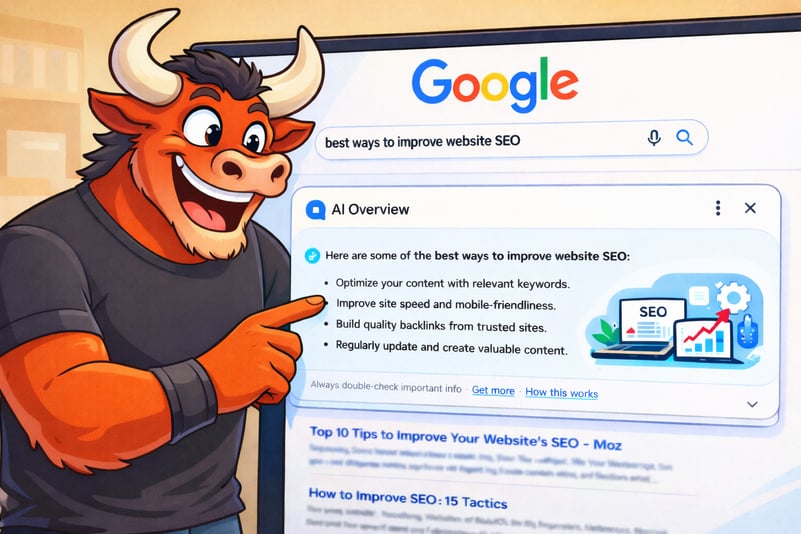
What Google AI Overviews Are
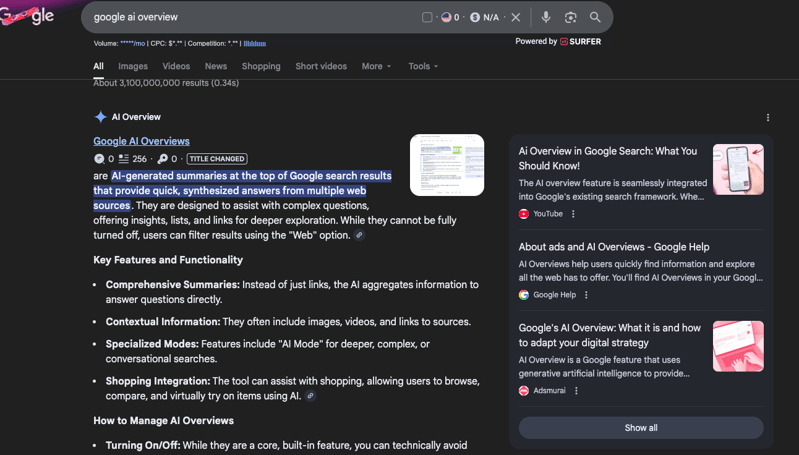
Google AI overviews are AI-generated summaries that appear at the top of some Google search results, with links to supporting sources. They are designed to answer a user’s question quickly while offering deeper resources below.
Google has stated that AI Overviews now reach billions of users across more than 200 countries and territories. This is core search behavior, not a beta feature.
Why You Should Optimize Content for Google AI Overviews
1. Traditional click patterns are changing
Research shows that users click fewer traditional search results when an AI summary appears. Pew Research found users clicked a standard result in 8% of visits when an AI summary was present, compared to 15% when it was not.
If clicks are shrinking, visibility inside the summary becomes more valuable.
2. Citations influence brand perception
When Google’s AI selects your content as a source, it positions your brand as credible. Users may not always click immediately, but repeated exposure builds recognition and trust. Over time, that can increase branded searches and direct visits.
3. AI Overviews often sit above all organic results
Even if you rank number one organically, AI Overviews will usually appear above you. That shifts what “top-ranking” means. Optimizing for citations is a way to compete in that higher visual layer.
4. Traffic quality may improve
Google has said that clicks from AI-influenced search experiences can be higher quality. That means fewer visits, but potentially stronger intent.
5. Early adaptation creates advantage
Many brands are still optimizing for traditional blue links only. Adjusting your structure and formatting now gives you a competitive edge while others are slow to respond.
How Google Chooses Content for AI Overviews
Google states there are no special requirements to appear in AI Overviews. The same core ranking systems apply.
- Your page must be crawlable and indexed.
- Your page must be eligible to appear with a snippet.
- Your content must be helpful, reliable, and clearly structured.
Google may also use a “query fan-out” process. That means it searches related sub-questions behind the main query and pulls supporting content from multiple sources.
That is why depth matters.
How to Optimize Content for Google AI Overviews
Step 1. Structure content around real questions
Break your topic into the exact questions users ask. Create one clear section per question.
Step 2. Define concepts before expanding
Give a direct definition in the first sentence. Then explain why it matters.
Example format: “Google AI Overviews are…” followed by a short explanation.
Step 3. Use clean heading hierarchy
Use one H1. Use H2s for major sections. Use H3s for supporting details. Clear hierarchy improves parsing and readability.
Step 4. Write in extractable blocks
Keep paragraphs focused. One idea at a time. Avoid vague transitions. Avoid filler. AI systems prefer concise, self-contained explanations.
Step 5. Support claims with data
AI models favor content that includes named sources, research, and specific numbers. When possible, cite reputable studies or official documentation.
Step 6. Improve technical foundations
- Ensure pages are indexed.
- Maintain internal linking.
- Match structured data to visible content.
- Keep page speed and mobile usability strong.
What Success Looks Like
Success may not mean more clicks immediately. It may mean:
- Higher impressions
- Increased brand searches
- Improved conversion rates from organic visitors
- Greater authority signals over time
Google includes AI feature traffic within Search Console reporting under Web search. Monitor impressions, branded queries, and assisted conversions, not just click volume.
Frequently Asked Questions
Why should businesses optimize content for google AI overviews?
Businesses should optimize content for google AI overviews because AI summaries reduce traditional clicks, increase brand exposure at the top of the SERP, and influence how users perceive authority.
Is optimizing for AI Overviews different from traditional SEO?
No. Google states that there are no special requirements. Strong SEO fundamentals still apply, but formatting and structure are more important than ever.
Does appearing in AI Overviews guarantee more traffic?
No. Click behavior may decrease overall, but visibility and authority can increase. Over time, this can lead to stronger branded demand and higher-quality visits.
How do I know if my content appears in AI Overviews?
You can monitor performance shifts in Google Search Console and manually review key queries where AI summaries appear.