You’re not trying to “get a new website,” you’re trying to make a smart decision you can defend internally. If you’re searching for how to choose a web design agency, you’re likely 3–6 months out from hiring. You’ve tried marketing before. Maybe SEO. Maybe paid ads. Maybe a redesign that didn’t move the needle. This time, you want clarity.
Key Summary:
- Choosing a web design agency is about strategy and revenue, not just design.
- Most failed redesigns break down due to poor discovery and unclear scope.
- You should evaluate process, technical ownership, reporting, and long-term support.
- Cheap projects often cost more due to rebuilds and missed revenue.
- The right partner can connect design to SEO, conversions, and measurable ROI.
What “Choosing a Web Design Agency” Actually Means
Choosing a web design agency is not about picking the best-looking portfolio. It means selecting a strategic partner who can connect your website to revenue.
A web design agency should define your positioning, clarify your messaging, design around conversion behavior, and build on a platform that supports growth.
If the agency only talks about colors and layout, that’s design. If they talk about customer journeys, search intent, CRM integration, and lead attribution, that’s strategy.
And strategy is what prevents rebuild number two.
Why Most Website Redesigns Fail
Let’s start broad. According to industry research from Forrester, companies that prioritize user experience see up to a 400% increase in conversion rates. Yet most redesigns focus on aesthetics first.
Here’s where failure usually happens:
- No defined goals
- Weak messaging carried over from the old site
- SEO not integrated during build
- No tracking or CRM alignment
- Launch and leave approach
If your last website didn’t perform, it likely failed in discovery, not development.
Step 1: Evaluate Strategy Before Design
If you want to know how to choose a web design agency, start here.
Ask how they run discovery.
A legitimate agency should start by gathering detailed information about the business. This usually includes an onboarding process that collects information such as industry, products or services, target audience, competitors, SEO keywords, and the core challenges the business is trying to solve.
The discovery process should also define business goals for the new website and KPIs that will measure success.
The agency should also request brand assets such as brand guidelines and logo files to ensure the design stays consistent with the company’s identity.
Next, the agency should analyze the current website by compiling a full list of existing pages and reviewing traffic data. This helps determine which pages should stay, which should improve, and which should be removed.
From there, the agency should create a new sitemap and hold a discovery or kickoff call to align on strategy before design begins.
If discovery includes structured onboarding, data analysis, a defined sitemap, and a strategy call, that’s a good sign.
Strategy comes first. Design supports it.
Step 2: Understand What You’re Actually Paying For
Web design pricing varies widely. In 2025, custom website projects typically range from $15,000 to $75,000+ depending on scope, integrations, and content needs.
Lower-cost projects often exclude:
- Conversion research
- SEO structure
- Copywriting
- CRM integration
- Ongoing optimization
When evaluating proposals, compare scope line by line. Are you paying for development hours only? Or for strategy, messaging, SEO, and testing?
If you’re unsure what should be included, review what’s typically offered in packages from established agencies. It gives you a baseline.
Step 3: Clarify Who Owns What
This is where many businesses get burned.
Before hiring, confirm:
- Who owns the domain?
- Who owns hosting?
- Who owns the CMS?
- Are you locked into proprietary systems?
If you’re considering platforms like WordPress, ask about hosting and long-term support. Reliable WordPress Hosting should include security, updates, a staging environment, and daily backups.
Ownership clarity prevents rebuild number two.
Step 4: Compare Agency vs Freelancer vs In-House
How to choose a web developer depends on your internal resources.
Freelancers are often cost-effective. But they usually specialize in one area. Design or development. Rarely messaging, SEO, CRO, analytics, and CRM.
In-house hires provide control, but carry overhead. According to Glassdoor, the average salary for a web developer in the U.S. exceeds $85,000 annually, not including benefits and tools.
An agency costs more upfront, but provides a team: strategist, designer, developer, SEO specialist, and project manager.
If you need accountability across disciplines, agency support usually wins.
Step 5: Measure Website ROI After Launch
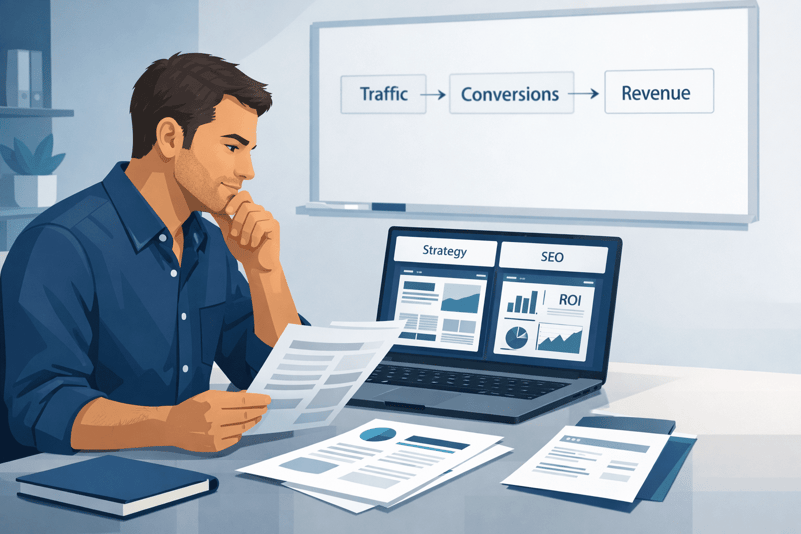
A website without tracking is a brochure.
Website ROI means revenue generated from leads or sales compared to the cost of the website investment. But measuring ROI is not just about the website itself. It also depends on how the business drives traffic to the site after launch.
A website can be built once. Traffic generation is an ongoing effort.
Many companies launch a new website and expect leads to appear immediately. In reality, the website is the foundation. The results come from the marketing that drives people to it.
That can include SEO, paid advertising, email marketing, social media, video content, and other digital campaigns.
A good agency should set up the analytics and tracking infrastructure during the build. But after launch, the business should actively monitor performance and evaluate how traffic and conversions grow over time.
Post-launch questions should include:
- How much traffic is coming to the website each month?
- Which marketing channels are driving visitors?
- How many leads or conversions are being generated?
- Which pages convert the best?
Many businesses also connect their website to a CRM system so they can track which leads turn into real revenue.
Performance should be reviewed regularly. Marketing and website performance are not one-time projects. They require ongoing optimization.
Google reports that improving page load speed by just one second can increase conversions by up to 20%. Technical performance, traffic generation, and conversion tracking all work together.
If a website launches without clear tracking, reporting, and a plan to drive traffic, it becomes difficult to know whether the investment is actually working.
Step 6: Look for Transparency, Not Hype
If you’re skeptical, that’s healthy. You should expect:
- Clear timelines
- Defined milestones
- Honest conversations about budget
- Real case studies with metrics
You should not hear:
- “We guarantee rankings.”
- “This will 10x your business.”
Reputation over revenue means long-term fit matters more than closing a deal.
What a Strong Web Design Proposal Should Include
Before you sign, confirm the proposal outlines:
- Discovery scope
- Sitemap and architecture
- Copywriting responsibilities
- SEO structure
- Development framework
- Hosting plan
- Post-launch support
- Reporting cadence
If any of these are vague, ask for clarification.
Red Flags to Watch For
- Extremely low pricing compared to market average
- No documented discovery phase
- No SEO integration
- No analytics setup
- No post-launch support options
And if you feel rushed, pause.
When Custom Web Design Isn’t the Right Move
Custom web design may not make sense if:
- You have no traffic strategy
- You lack internal marketing ownership
- Revenue is inconsistent
- Your offer is still evolving
In those cases, start smaller. Clarify positioning. Improve messaging. Then invest.
But if you’re generating traffic and leads are leaking due to poor structure, custom design becomes a growth lever.
Making a Decision You Can Defend
If you’re evaluating how to choose a web design agency, your goal is risk reduction.
You want clarity on:
- Investment
- Scope
- Timeline
- Ownership
- ROI measurement
And you want a partner who can explain it plainly.
If you’re ready to have that conversation, you can Contact us or Request a Quote. We’ll walk through scope, budget, and whether it’s even the right time.
Frequently Asked Questions
How do I know if a web design agency is legitimate?
A legitimate web design agency provides documented processes, measurable case studies, clear contracts, defined scope, and transparent pricing. They explain how strategy connects to revenue and can outline how results are tracked.
How much should I budget when choosing a web design agency?
Most custom website projects range from $15,000 to $75,000 depending on scope and integrations. The budget should reflect strategy, messaging, SEO, development, and post-launch support.
What is the difference between a web designer and a web developer?
A web designer focuses on layout and user interface. A web developer builds the technical functionality. When learning how to choose a web developer, confirm they understand performance, integrations, and security.
Should SEO be included in a web design project?
Yes, SEO should be integrated during structure and development. Retrofitting SEO after launch often increases cost and reduces performance potential.