If you’re reading this, you probably already believe in SEO.
You just don’t trust SEO agencies.
That skepticism is earned. Most businesses that come to us have tried SEO before. Traffic increased. Reports looked fine. Revenue didn’t move in a meaningful way. Eventually, the relationship ended without a clear explanation of what went wrong.
This guide is here to help you avoid that outcome.
Not by telling you who to hire — but by showing you how to evaluate an SEO agency before you sign anything.
Why Most SEO Agency Relationships Fail
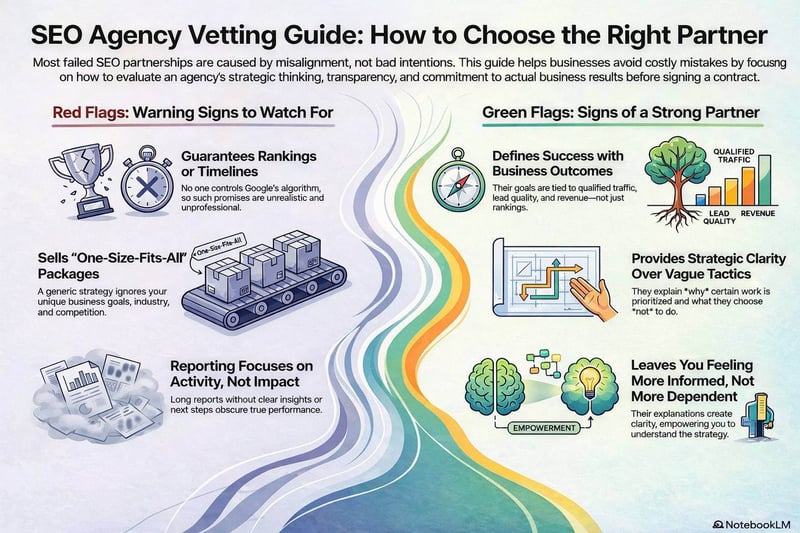
Most SEO failures aren’t caused by bad intentions.
They’re caused by misalignment.
The most common issues we see:
- The agency optimizes for rankings instead of outcomes
- Success metrics aren’t tied to revenue or leads
- Strategy is vague or templated
- Reporting focuses on activity, not impact
- No one is accountable for results
If an agency can’t explain why they’re doing something — or how it connects to your business — that’s not strategy. It’s motion. It’s just being busy to say you’re busy.
The Questions You Should Ask Before Hiring an SEO Agency
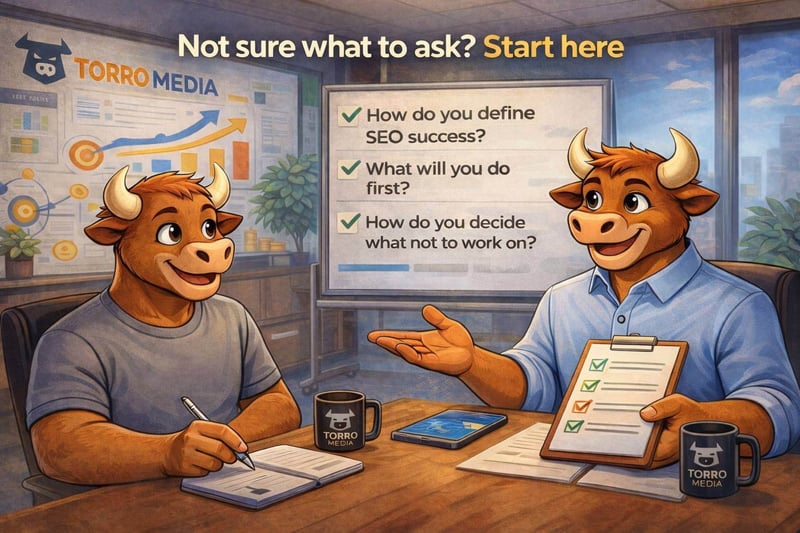
A strong agency welcomes hard questions. Weak ones deflect them. Here’s a quick and dirty list of the most important questions you should ask before signing on with an SEO agency.
1. How do you define SEO success for a business like mine?
Good answers reference:
- Qualified traffic
- Conversions or lead quality
- Clear milestones and expectations
Be cautious if the answer focuses only on:
- Rankings
- Impressions
- “Visibility” without business context
2. What will you actually do in the first 90 days?
You’re not asking for tactics. You’re asking for clarity.
A real answer includes:
- Technical foundations
- Search intent or content strategy
- Measurement setup
- Clear priorities
Vague answers usually sound like:
- “We’ll audit and optimize”
- “We’ll build authority”
- “It depends” (without explanation)
3. How do you decide what not to work on?
This question shows real strategic thinking. In SEO, opportunities are endless, but time and resources are not. Strong strategy is about focus—and knowing what to ignore. When everything is a priority, nothing is.
Red Flags in SEO Proposals
Some warning signs show up fast. Most are written directly into the proposal.
We see this after the fact—when companies come to us frustrated, embarrassed, and sometimes angry. They didn’t “ignore SEO.” They trusted the wrong promises.
- Guaranteed rankings or timelines
No one controls Google. Not us. Not anyone.
When a proposal guarantees rankings, traffic, or timelines, it’s usually a sign of inexperience—or worse, dishonesty. We’ve seen clients locked into long contracts based on promises that could never be kept, only to be told later that “the algorithm changed.”
While with solid strategy and intention there’s a lot you can expect, SEO involves variables you can’t control. Anyone claiming otherwise is selling certainty that doesn’t exist.
One size fits all packages
Your business isn’t generic. Your SEO strategy shouldn’t be either.
We regularly talk to teams that paid for “gold” or “platinum” packages that looked impressive on paper but had nothing to do with their actual goals. Same blog cadence. Same tactics. Same playbook—regardless of industry, competition, or constraints.
That approach leaves so much untapped potential and opportunity on the table.
Vague monthly deliverables
If you can’t tell what’s being worked on, you can’t evaluate progress.
This is one of the most common and damaging issues we see. Monthly reports filled with buzzwords, but no clear explanation of what was done or why it mattered. Clients feel stuck—paying invoices without understanding where their money is going or how success is being measured.
Opacity protects the agency, not the client. At Torro, we geek out over pulling back the curtain and letting you see all the progress we’re seeing on our end and will often ping you to “check this out” or “get a look at this.” (Small plug, but it’s true)
Reports without interpretation
Data without insight doesn’t help you make decisions.
We’ve seen reports that are 30 pages long and still leave leadership confused. Rankings up. Traffic down. Conversions unclear. No context. No guidance. No next steps.
That’s why reporting should do more than dump numbers. Our dashboard is built to shape recurring agendas and client syncs—not just summarize the past, but guide the conversation forward. We walk through it with you on video, configure it around your actual goals, and use it to answer real questions: what changed, why it changed, and what we’re doing next.
Reporting should create clarity, not anxiety. And it should work for you—not against you.
What Real SEO Accountability Looks Like
Accountability isn’t long reports or frequent emails.
Accountable SEO looks like:
- Clear goals tied to business outcomes
- Leading indicators that signal progress
- Honest conversations when something isn’t working
- Strategy adjustments based on performance, not assumptions
A good agency doesn’t just show you what happened. They explain why — and what changes next.
SEO isn’t always the right move—especially if:
- Your offer isn’t clearly differentiated
- Your site doesn’t convert visitors into leads
- You need immediate results, not long-term growth
- There’s no internal buy-in for content or change
A credible agency will say this upfront—even if it means delaying or losing the sale.
How to Compare SEO Agencies Without Being an Expert
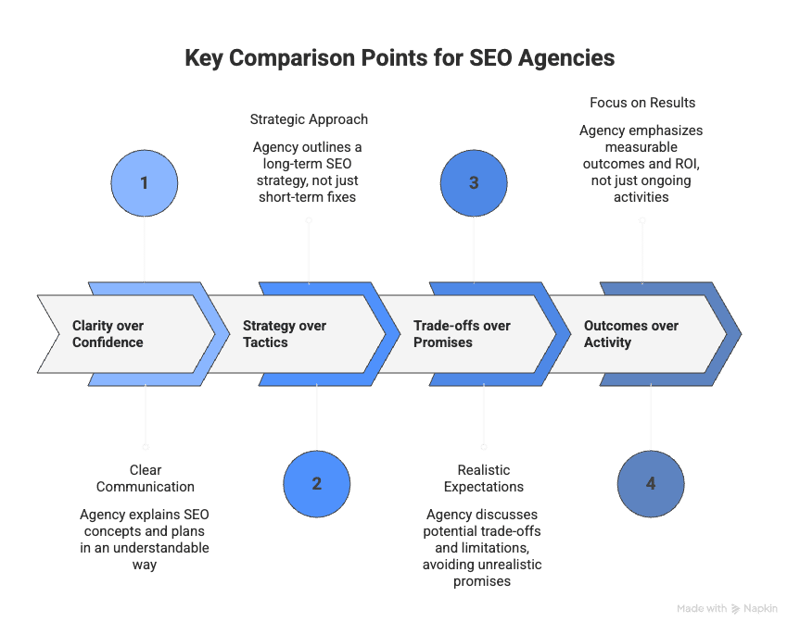
You don’t need to understand SEO to choose well. You need a way to judge how an agency thinks. Ignore how confident they sound. Focus on how clearly they explain their decisions.
Clarity over confidence
Confidence is easy. Clarity is harder. A strong agency should make it easy for you to:
- Explain their approach in plain language
- Understand why certain work comes first
- Know how decisions will change if results lag
If you leave a call impressed but unable to explain the plan, that’s a risk.
Strategy over tactics
Tactics are actions. Strategy is direction.
Good agencies start with:
- Business goals
- Buyer intent
- Competitive reality
Weak agencies jump straight to:
- Keywords
- Links
- Content volume
If the plan doesn’t clearly connect SEO work to how your business generates revenue, it’s not a strategy.
Trade-offs over promises
Every SEO plan has limits.There will always be things an agency chooses to:
- Focus on
- Delay
- Not do at all
Pay attention to whether they talk about those trade-offs. Promises without trade-offs usually aren’t realistic.
Outcomes over activity
SEO creates a lot of visible work. That doesn’t mean it’s effective.
Ask:
- How does this attract better leads?
- How will we know this is working early?
- What happens if it isn’t?
Agencies that emphasize activity report effort. Agencies that emphasize outcomes design work around results.
The One Question That Matters
After each conversation, ask yourself:
Do I feel more informed — or more dependent?
The right agency should make the decision easier to explain, not harder. That’s usually the difference between a smart hire and an expensive lesson.The right agency should make you feel more informed, not more overwhelmed.
Final Thoughts
If the process feels rushed, overly polished, or hard to pin down, it’s okay to slow things down. The right partner won’t pressure you into a decision. They’ll help you understand the trade-offs and make a choice you feel good about — even if that choice takes time.
At Torro Media, our goal isn’t to convince everyone to work with us. It’s to help you ask better questions, avoid common mistakes, and make a smarter decision for your business.
If you want a second opinion before committing, you can request a no-pressure SEO reality check. No pitch. No obligation. Just an honest look at whether SEO — and which approach — actually makes sense for you right now.
And if we’re not the right fit, that’s okay too. This guide did its job if you leave with better questions, a clearer framework, and the confidence to choose the right partner for your business — whether that’s us or not.
FAQ: Choosing the Right SEO Agency
How long does SEO take to work?
Most businesses see early signals in 60–90 days and meaningful results in 6–12 months.Timelines vary based on competition, site quality, and strategy.
What should SEO reporting actually show?
What changed, why it changed, and what happens next. Data without interpretation isn’t useful.
How do I know if an SEO agency understands my business?
They define success in terms of leads, revenue, or buyer intent—not just rankings or traffic.
Is SEO worth it for every business?
No. SEO may not be right if your offer isn’t differentiated, your site doesn’t convert, you need immediate leads, or there’s no internal buy-in.
How can I compare SEO agencies without being an SEO expert?
Focus on clarity. If you can’t explain their plan, it’s a risk.
What questions should I ask before hiring an SEO agency?
Before hiring an SEO agency you should ask how success is defined, what won’t be done, how progress is measured, and what happens if results stall.
What are the most common SEO mistakes?
Common SEO mistakes are chasing rankings, ignoring conversions, unclear reporting, and misaligned goals.