Generic AI content fails for one reason. It has no lived experience.
This method fixes that by forcing your expertise into the draft before the writing happens.
TLDR Key Summary
- Find real questions people ask about your topic
- Feed one question into ChatGPT
- Make ChatGPT ask you 5 questions first
- Answer those out loud with voice dictation
- Then have ChatGPT write using your answers as the source material
- You get an article that sounds human because it is human
What Human SEO means
Human SEO is content that is built from real experience.
It is not just correct. It is specific.
It includes:
- Mistakes you have seen
- Decisions you made
- Results you got
- Examples you can name
- Details a generic model cannot guess
That is what Google and readers reward.
Why generic AI blog posts do not perform (as good)
Here’s what happens with a normal AI blog prompt.
You ask: write me a blog post about X.
AI responds with a clean structure and generic advice.
The problem is not grammar. The problem is sameness.
It looks like every other article.
- No unique examples
- No real constraints
- No proof
- No opinions rooted in actual work
So people bounce.
And the page never earns trust signals.
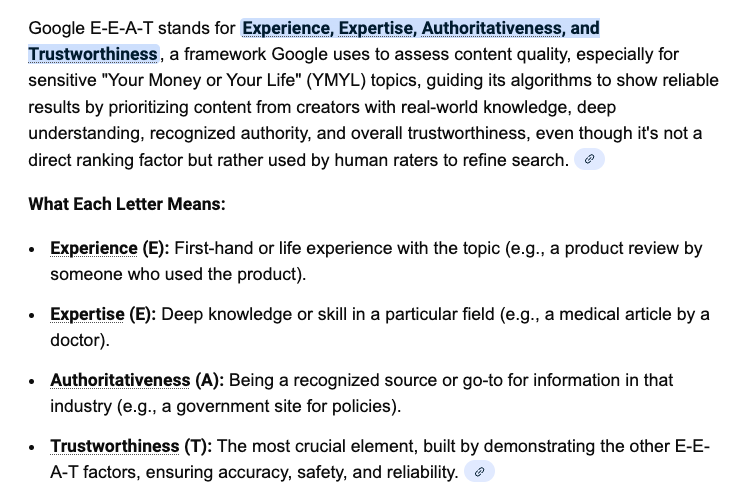
You need to use EEAT:

The SEO Hack: Make AI interview you before it writes
This is the whole trick.
Do not ask for an article.
Ask for questions. Then answer them with your voice.
Now the draft has the raw material that search engines and humans can feel.
Step 1: Find a real question people are searching
Start with the question, not the keyword.
Use a questions tool like:
- SEOQuestions.ai
- Google autocomplete
- People Also Ask boxes
Pick one question that is:
- Specific
- Common
- Intent driven
Examples:
- How long does SEO take for a local business
- Why is my Google Ads cost per lead going up
- Does blogging still work in 2026
Step 2: Use this prompt in ChatGPT
Paste the question into the prompt below.
Then let ChatGPT ask you 5 questions.
The Human SEO Prompt
Copy and paste this into ChatGPT and replace the bracketed part
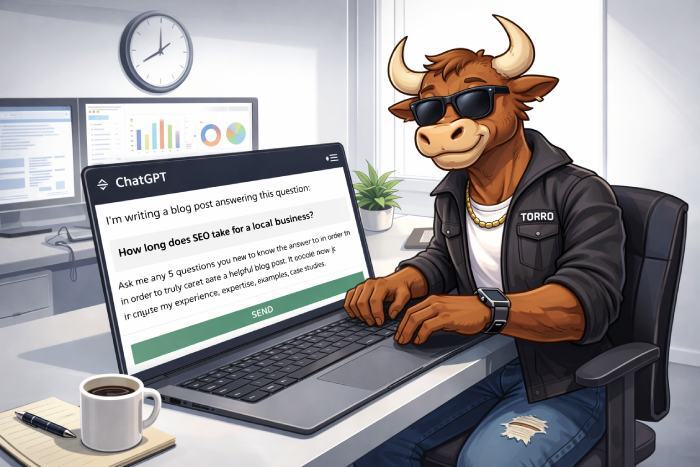
I’m writing a blog post answering this question: {INSERT YOUR QUESTION HERE}

Ask me any 5 questions you need to know the answer to in order to create a truly unique, helpful blog post.

It should include my real experience, expertise, examples, and case studies.

After I answer, write the article in a natural human tone. Use my answers as the primary source. If something is uncertain, ask a follow up question instead of guessing.

Include:
- A short TLDR section after the first paragraph
- Clear subheadings
- Direct question and answer sentences for the main topic
- A practical step by step section
- A short conclusion with next actions
Step 3: Answer the questions using voice dictation
This part matters more than the prompt.
Talk like you talk.
Give details like:
- What you did first
- What you changed
- What surprised you
- What worked and what did not
- Numbers if you have them
- A named example from a real client or project
If you cannot share names, anonymize them:
Client A, local HVAC company, ecommerce brand, multi location restaurant.
Step 4: Have ChatGPT write, then tighten it
Once ChatGPT writes the article, do two quick passes.
Pass 1: Add specificity
Ask:
- Where can I add one real example
- Where can I add one mistake to avoid
- Where can I add one simple checklist
Pass 2: Make it skimmable
Add:
- Short bullets
- A small table if useful
- Short paragraphs
- Clear subheadings

How to publish it on your site so it performs
Do not overthink this. Do the basics well.
On page SEO checklist:
- Put the exact question in the H1
- Use a short clean URL
- Answer the question in the first 2 to 3 sentences
- Add a TLDR right after the intro
- Use the question phrasing in at least one H2
- Add an FAQ section with 3 to 5 related questions
Add a credibility section
One short section that shows you are real.
Example:
Why you can trust this answer
I have done this for X type of businesses. Here is what I see most often.
That single section can separate you from template content.
A simple example workflow you can copy every week:
- Pick one question from a questions tool
- Run the Human SEO prompt
- Answer by voice in 3 minutes
- Generate the draft
- Add one example, one checklist, one takeaway
- Publish and internally link it to one related page
- Share the link on social
Do that consistently and you build topical authority fast!