If you are spending thousands on influencer marketing and not seeing sales, the issue is usually not influencer marketing. The issue is how the campaign is structured.
TLDR / Key Summary
- Micro-influencers with 10,000 to 100,000 followers deliver 36% positive ROI on average
- Mega-influencers with millions of followers lose money 59% of the time
- Follower count is a weak predictor of ROI
- Trust and engagement drive conversions, not reach
- UTM links and a creator ranking sheet tell you what to scale and what to cut
- Payment structure can protect profit or destroy it
Let’s break this down into a system you can run repeatedly.
Influencer Size vs ROI Performance
| Influencer Tier | Follower Range (X-Axis) | Average ROI Outcome (Y-Axis) | Performance Trend |
|---|---|---|---|
| Micro-Influencers | 10,000 – 100,000 followers | +36% Positive ROI (Average) | Consistently Profitable |
| Mega-Influencers | 1,000,000+ followers | 59% of Campaigns Lose Money | High Risk / Negative ROI Likely |
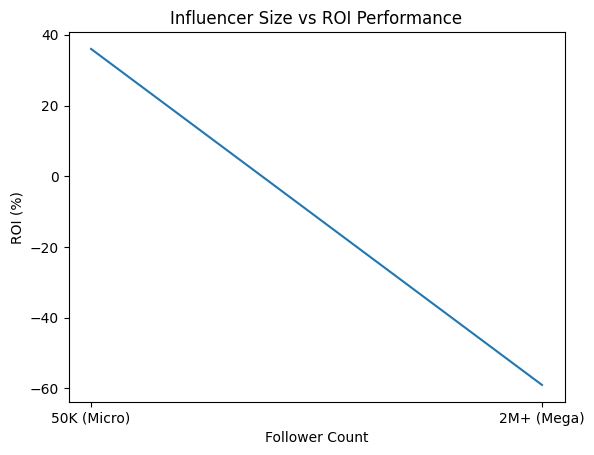
Note: Notice the steep decline once influencers get "too big"
What is influencer marketing ROI?
Influencer marketing ROI is the measurable profit generated from an influencer campaign after subtracting total costs.
ROI formula: (Revenue minus Cost) divided by Cost
Example: If you spend $10,000 and generate $16,000 in tracked revenue, ROI is 60%.
The problem is most brands track the wrong outputs. They track impressions and likes instead of sales and profit.
Why most influencer campaigns lose money
Most brands pay for reach. Buyers respond to trust.
When a creator has millions of followers, their audience behaves like a crowd. Crowds scroll and tap. Communities ask questions and buy.
When NP Digital analyzed 2,808 influencer campaigns, the results were clear:
- Micro-influencers (10,000 to 100,000 followers) produced 36% positive ROI on average
- Mega-influencers underperformed and delivered negative ROI in 59% of campaigns
That gap is not small. It changes how you should allocate budget.
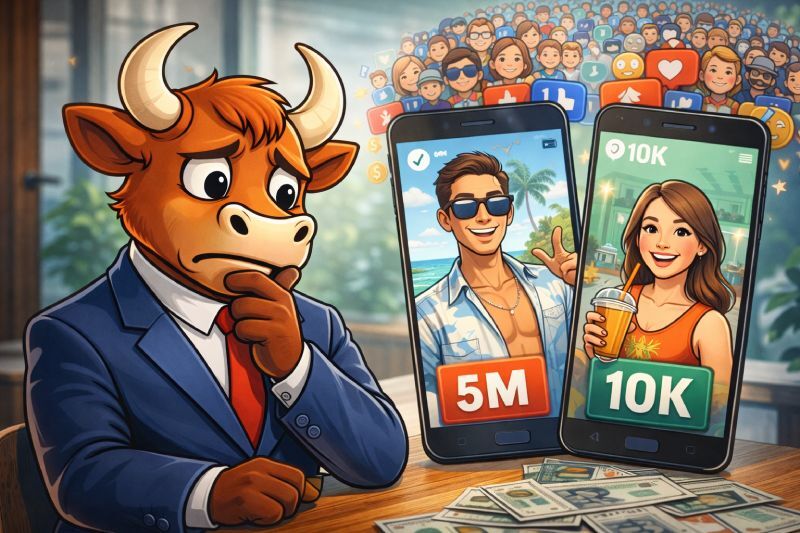
Micro-influencers vs mega-influencers: which has better ROI?
Micro-influencers usually have better influencer marketing ROI because their audiences trust them more and engage more deeply.
Micro-influencers (10K to 100K followers)
- Higher engagement
- Lower cost per post
- More trust
- Easier to test at scale
- Content feels real
Mega-influencers (1M+ followers)
- More reach
- Higher fees
- Lower engagement relative to audience size
- Lower conversion rate
- Higher risk per campaign
For the price of one celebrity partnership, you can often activate dozens of micro-influencers. That diversification reduces risk and increases the odds you find creators who convert.

You are not buying reach. You are buying trust
Influencer marketing works when content feels like a recommendation. It fails when it feels like an ad.
If you script creators, force robotic talking points, or over-produce the content, you remove the reason their audience listens.
High-performing campaigns do this instead:
- Give creators a goal
- Give key product facts and guardrails
- Provide usage guidelines
- Provide disclosure requirements
- Let them create in their own voice
You can still approve content before it goes live. You just should not write the post for them.
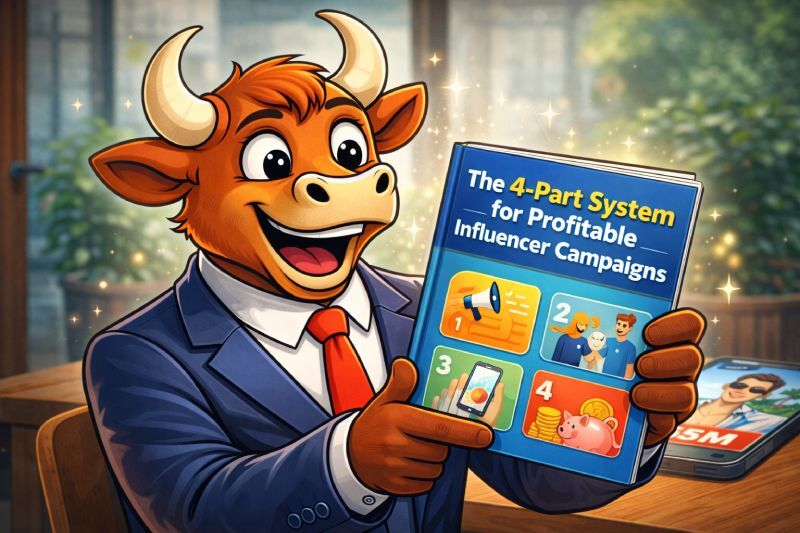
The 4-part system for profitable influencer campaigns
Most brands run influencer campaigns like one-off experiments. The teams that win run a repeatable system.
1. Create a campaign-specific hashtag
Create one simple hashtag tied to the campaign theme, not just your brand name. Require every creator to use it.
This does three things:
- Makes content discoverable
- Creates a trackable trail you can reshare
- Builds social proof as more creators participate
2. Use micro-influencers as a UGC flywheel
Micro-influencers are user-generated content machines. Their content can become:
- Paid ads
- Landing page proof
- Email creative
- Retargeting assets
Instead of one polished studio shoot, you get real people using your product in real life. That is the content people trust.
3. Make sponsored posts look like normal content
The best-performing sponsored posts feel like the creator’s usual vibe. Let it be human. Let it be in their environment. Let it match how they normally post.
When content looks like what the audience already engages with, it feels credible. Credibility drives action.
4. Tell a story, not a product pitch
Storytelling beats straight promotion.
When you brief creators, give them story formats to choose from:
- Day in the life
- Before and after
- Problem to solution
Stories stick. Features do not.
.jpg?width=800&height=533&name=Torro%20Media%20Tracking%20Influencer%20ROI%20(1).jpg)
How to track influencer marketing ROI
Most brands think influencer marketing does not work because tracking is weak. They miss the signals that show profitability.
Track what matters
Platform metrics like reach and views are useful. They are not ROI.
The metrics that usually correlate to sales are:
- Saves
- Shares
- Comments with intent
- Website clicks
- Sales
Saves and shares show the content resonated. Clicks show interest. Sales show conversions.
Use UTM links for every creator
Give every creator a unique UTM link. Track performance in Google Analytics.
This tells you:
- Which creator drove real traffic
- Which format drove action
- Where to reinvest
If you want consolidated reporting, platforms like Aspire, Upfluence, or CreatorIQ can help. But you can start with UTMs and a spreadsheet today.
Create a simple creator ranking sheet
Before launch, decide which three metrics define success. A common set is saves, clicks, and conversions.
After the campaign, rank creators by those metrics. Renew top performers. Drop the rest.

How to structure influencer deals that protect profitability
The way you pay influencers determines whether you make money or lose it.
Model 1: Flat fees
Flat fees are the most common model. You pay a set rate per post, usually based on follower count and engagement.
Micro-influencers typically charge $100 to $1,000 per post depending on audience quality and size.
Use flat fees when you need guaranteed output and you already know the creator converts.
Model 2: Product or in-kind
This is product in exchange for content.
Use product-only deals to test first-time partnerships before committing cash. If performance is strong, upgrade them to paid deals in the next round.
Model 3: Affiliate or commission based
You pay a percentage of sales generated through a unique link or code.
This aligns incentives. Creators make money only when you make money.
Use affiliate deals when testing new creators at scale or when you want long-term partnerships without upfront risk.
The best approach is a tiered system
Do not use one payment model for everyone.
- New creators start with product-only or affiliate deals
- Proven creators move to flat fees
- Top performers get hybrid deals, flat fee plus performance bonus
This protects margin while rewarding the creators who actually drive profit.

Step-by-step launch plan for a profitable influencer campaign
This is the playbook you can run this month.
Step 1: Define your campaign
- Pick the product or offer
- Identify the target persona
- Choose one campaign angle
- Create one campaign hashtag
Step 2: Build your creator list
Find 30 to 50 micro-influencers in the 10,000 to 100,000 follower range. Use tools like Aspire, Upfluence, CreatorIQ, or creator marketplaces.
Vet for audience relevance, engagement quality, and consistency.
Step 3: Outreach with context
Tell them why you want to work with them and why their audience is a fit. Give a clear campaign angle and creative freedom.
Do not send scripts.
Step 4: Create a one-page brief
Include:
- Story direction options
- Key talking points
- Hashtag
- Unique UTM link
- Disclosure guidelines
Step 5: Build your repurposing plan
From every creator post, extract:
- Two to three ad variations
- Three hooks
- One testimonial style cut
- One retargeting asset
This turns influencer spend into compounding value across your marketing stack.
Step 6: Measure and iterate
Rank creators by saves, shares, clicks, and sales. Renew top performers. Drop the rest. Keep a rolling bench of proven creators you can activate any time.
Is influencer marketing still worth it in 2026?
Yes. Influencer marketing budgets are growing because it is still driving measurable results when structured correctly.
What changed is the strategy. Brands that pay for reach lose money. Brands that pay for trust build profit.
Final takeaway
You do not need the biggest creators to win.
You need a system that focuses on trust, story formats that feel real, tracking that shows profit, and deal structures that protect margin.
If you do that, influencer marketing stops being a vanity play and becomes a repeatable growth channel.
If you're looking for local Boston Influencers, let us know!