If someone in Boston is hungry and searching for where to eat tonight, they're turning to Google. And if your restaurant isn't showing up in the first few results — or worse, not showing up in the map pack at all — that table is going to your competitor down the street.
SEO for restaurants is one of the highest-ROI digital investments a food business can make, and it's also one of the most misunderstood. As a Boston SEO agency, we work with local businesses across the city — this guide covers exactly what works, what doesn't, and what Boston food businesses specifically need to do to get found.
Why Restaurant SEO Is Different
Most SEO advice is written for B2B companies or e-commerce brands. Restaurants are a different beast. Your customers are searching with high intent and low patience — terms like "best Italian near me" or "open now Boston" — and making decisions in under 60 seconds based on what they see in search results.
That changes the strategy significantly. For restaurants, local SEO — specifically Google Business Profile, map pack visibility, and review management — matters more than traditional content SEO. But both work together, and ignoring either leaves money on the table.
Step 1: Get Your Google Business Profile Right
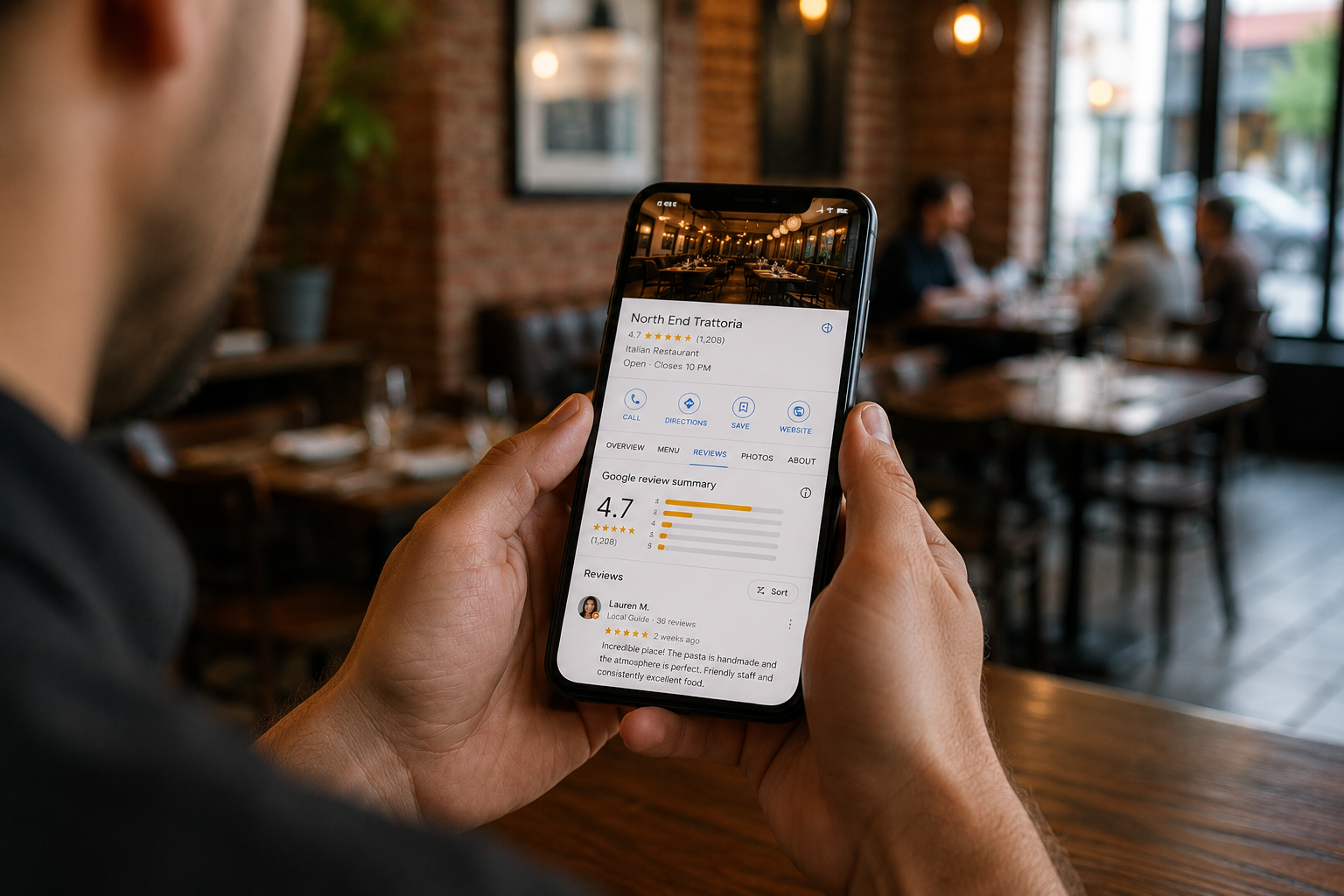
Your Google Business Profile (GBP) is the single most important SEO asset your restaurant has. It's what powers the map pack, shows your hours and photos, and surfaces your reviews. If it's incomplete or inaccurate, no amount of website optimization will save you.
Business name: Your real business name — no keyword stuffing. Adding "Best Cannoli" or "Boston North End" to your listing name violates Google's guidelines and risks suspension.
Category: Choose your primary category carefully. "Restaurant" is too broad. If you're a pizza place, use "Pizza Restaurant." If you're a bakery, use "Bakery." Google uses your category to determine when your listing appears in relevant searches.
Hours: Keep these obsessively up to date, including holiday hours. Nothing kills a first impression like showing up and finding the door locked because your GBP says you're open.
Photos: Restaurants with more than 100 photos on their GBP get significantly more direction requests and clicks than those with under 10. Post food photos, interior shots, and team photos regularly. Authentic photos outperform polished professional shoots for engagement.
Posts: Use the GBP Posts feature for specials, events, and seasonal menu items. Treat this like its own social media feed. These appear directly in your search listing and signal to Google that your profile is actively managed.
Q&A: Seed your own Q&A section with the questions customers actually ask — "Do you take reservations?", "Is there parking nearby?", "Are you dog-friendly?" — and answer them yourself before anyone else does.
Step 2: Nail Your NAP Consistency
NAP stands for Name, Address, Phone number. It needs to be identical — not just similar, identical — across every platform where your restaurant is listed: your website, Google, Yelp, TripAdvisor, OpenTable, Facebook, and any local directories.
A mismatch as small as "St." versus "Street" in your address can confuse Google's local algorithm and suppress your map pack ranking. Run a citation audit and clean these up. It's tedious work, but it's foundational to everything else performing correctly.
Step 3: Build Your Review Velocity
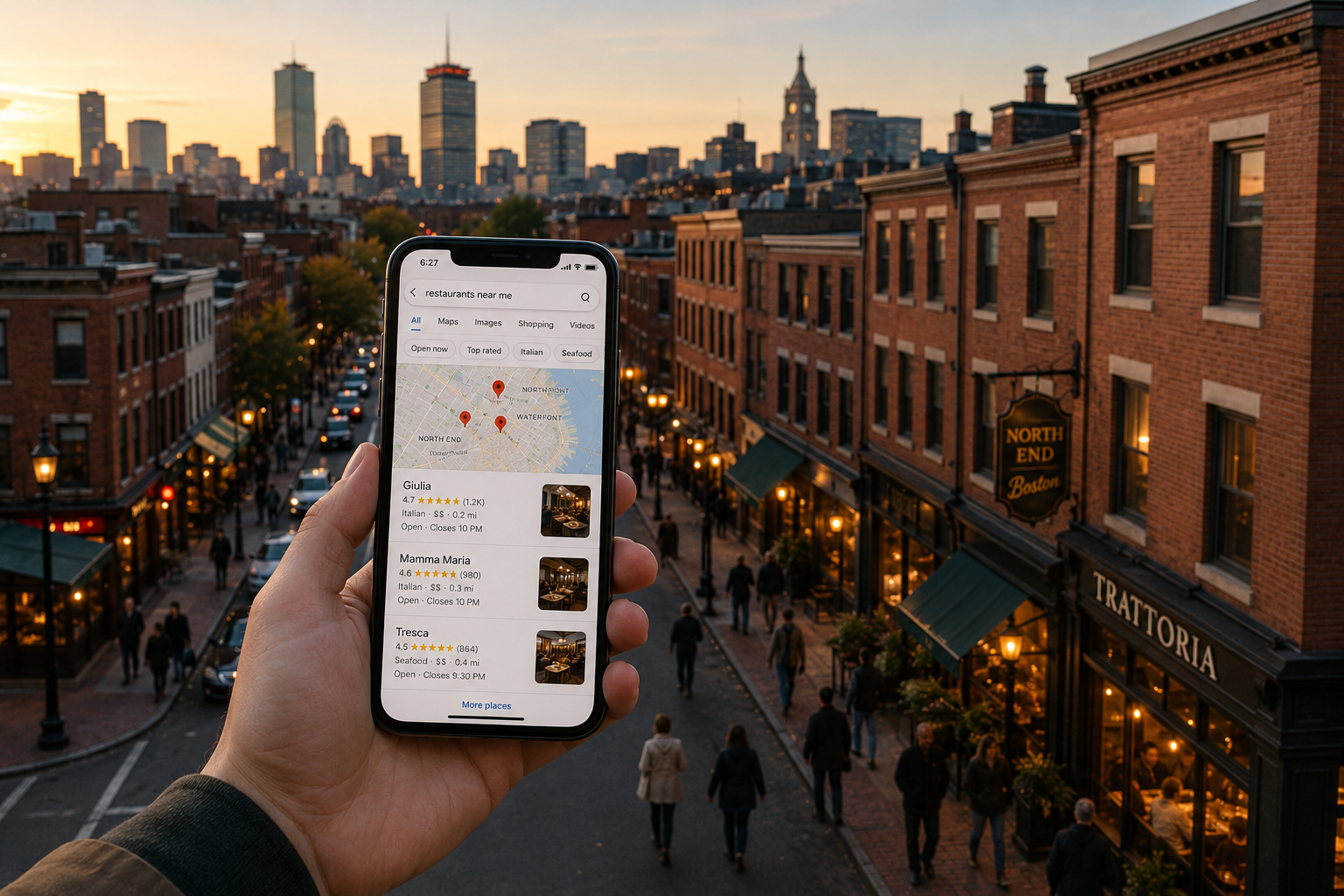
Reviews are the social proof layer of local SEO. Google's algorithm factors in review quantity, recency, and average score when ranking local businesses. A restaurant with 50 reviews from the past 6 months will outrank one with 200 reviews that stopped coming in two years ago.
The best time to ask for a review is right after a positive interaction — when a customer compliments the food or service, that's your moment. Make it frictionless by creating a short direct link to your Google review page and putting it on receipts, table cards, and any post-visit email you send. Respond to every review, positive and negative — Google notices response activity and it signals professionalism to prospective diners reading your listing.
What you should never do: ask for reviews in bulk, use review gating, or offer incentives. Google's guidelines prohibit these practices and the risk of suspension is just not worth it.
Step 4: Optimize Your Website for Local Search
Your website supports your GBP — they work as a pair. Your homepage title tag should include your restaurant type and the city. Something like "Mike's Pastry | Italian Bakery in Boston's North End" is more effective than just your business name alone.
If you have multiple locations, each one needs its own dedicated page with unique content, its own NAP, and its own embedded Google Map. Schema markup tells Google structured information about your business — cuisine type, price range, hours, menu URL — and it's increasingly read by AI search platforms as well as traditional search engines.
Page speed is non-negotiable. Boston diners searching on their phones will leave a slow-loading site instantly. Most restaurant websites score in the 40s and 50s on Google's PageSpeed Insights — a score that low is actively costing you traffic.
One commonly overlooked issue: if your menu is only available as a downloadable PDF, Google can't reliably index it. You're invisible for "restaurants that serve X" searches until that menu content lives as actual HTML text on the page.
Step 5: Create Local Content That Earns Rankings
Once your GBP and technical foundation are solid, content is what separates restaurants that rank for category searches from those that only rank for their own name.
Neighborhood-specific pages work well — if you're in the North End and serve brunch, you should have a page that earns the "best brunch North End Boston" search. Event and occasion pages targeting searches like "Valentine's Day dinner Boston" or "corporate lunch catering Boston" have real search volume and almost no competition from individual restaurants. If you're known for a specific dish, write about it — "best cannoli in Boston" is a search people make, and the restaurant with the most relevant, authoritative content for that query earns the click.
What Good Restaurant SEO Results Look Like
Done right, restaurant SEO compounds over time. Within 3 to 6 months of a proper local SEO campaign, you should expect improved map pack placement for your primary cuisine and neighborhood keywords, more direction requests and phone calls from Google (both trackable in GBP Insights), increased organic website traffic from local search, and higher review velocity as more customers find and visit you.
The restaurants that rank well on Google in Boston aren't necessarily the most famous or the most expensive. They're the ones that treat local SEO as infrastructure, not an afterthought.
Not sure where your restaurant stands on Google right now? Run a free local SEO audit and see exactly what's holding you back. Or if you'd rather have someone handle your SEO, contact our team to see how Torro approaches local search for Boston food businesses.
Frequently Asked Questions
How does SEO for restaurants differ from regular SEO?
SEO for restaurants is primarily local SEO. Restaurant customers search with high intent and low patience — terms like "best Italian near me" or "open now Boston" — and make decisions in under 60 seconds based on map pack results, reviews, and photos. That means Google Business Profile optimization, review velocity, and NAP consistency matter more than traditional content SEO tactics like link building or keyword density.
How long does restaurant SEO take to show results?
With a solid local SEO foundation in place — optimized Google Business Profile, accurate NAP across directories, active review generation — most Boston restaurants see measurable improvement in map pack placement and direction requests within 3 to 6 months. Competitive neighborhoods like the North End or Back Bay may take longer due to the density of established listings.
What is the most important SEO factor for a Boston restaurant?
Your Google Business Profile is the single most important SEO asset a restaurant has. It powers your map pack listing, surfaces your hours and photos, and shows your reviews directly in search results — all before a customer ever visits your website. An incomplete or inaccurate GBP will suppress your local rankings regardless of how well your website is optimized.
Does a restaurant need a blog for SEO?
Yes — restaurants that treat content as optional are handing long-tail searches to whoever does publish. Terms like "Valentine's Day dinner Boston" or "private dining Back Bay" have real intent behind them and almost no competition from individual restaurants. Consistent content also builds topical authority, which compounds over time and expands the number of searches your site is eligible to appear in. Perhaps most importantly, AI platforms like ChatGPT and Google's AI Overviews recommend restaurants based on indexed content — a restaurant with blog content gives them something to cite, a restaurant with only a menu and address gives them less.
How do I get my Boston restaurant to show up in the Google map pack?
Map pack ranking is driven by three factors: relevance, distance, and prominence. To improve your map pack placement, fully optimize your Google Business Profile with the correct category, complete service listings, regular photos and posts, and an active review response strategy. NAP consistency across all directories reinforces your location signal to Google's local algorithm.
Can I do restaurant SEO myself or do I need an agency?
The foundational work — claiming and optimizing your Google Business Profile, fixing NAP consistency, and setting up a review request process — can be done by any business owner with time and attention. Where an agency adds value is in technical on-page optimization, schema markup implementation, content strategy, and ongoing monitoring. If your restaurant is in a competitive neighborhood or you're not seeing growth after 6 months of DIY effort, Torro's free SEO assessment is a good starting point. Contacting us for an initial consultation is another great place to start.