
Many business owners and marketing managers decide to invest in SEO services without first ensuring their website is actually ready for a campaign. This leads to wasted budgets and frustration when rankings do not improve as expected. Completing a proper website audit before SEO ensures your site has the technical foundation needed for long term growth.
Search engine optimization is not a magic fix for a broken website. It is an accelerator for a high quality, technically sound digital asset. If your site has technical errors or poor user experience, even the strongest backlink strategy will struggle to produce results.
Understanding what to fix before investing in SEO helps businesses avoid common mistakes and ensures their marketing budget is spent on growth rather than repairs.
Why Your Website Needs a Technical Foundation Before SEO
A website audit before SEO evaluates the technical health, structure, and usability of a site to ensure search engines can crawl, index, and rank its pages correctly. Without this preparation, even well optimized content can remain invisible in search results.
Think of your website like a house. SEO acts as the renovation that attracts visitors and improves value. However, if the foundation is weak or the structure is unstable, the improvements will not last.
Google prioritizes websites that provide strong user experiences. Fast loading pages, clean architecture, and clear navigation all signal quality. Fixing foundational issues first allows SEO strategies to focus on growth rather than troubleshooting.
Why Most SEO Campaigns Fail
Many SEO campaigns fail because the website was not prepared for optimization. Technical barriers prevent search engines from understanding the site, while poor user experience causes visitors to leave quickly.
Businesses often assume SEO services will solve all visibility problems. In reality, unresolved website issues often block improvements before they even begin.
| Common Failure Reason | Impact on SEO Campaign | How to Avoid It |
|---|---|---|
| Poor Technical Health | Search engines cannot properly crawl or index the website. | Perform a full website audit before SEO begins. |
| Slow Page Speed | Users abandon the site and rankings decline. | Improve Core Web Vitals and hosting performance. |
| Weak Conversion Paths | Traffic increases but leads remain low. | Improve landing pages and calls to action. |
| Missing Tracking | No reliable way to measure SEO performance. | Install GA4 and Google Search Console. |
The SEO Readiness Checklist
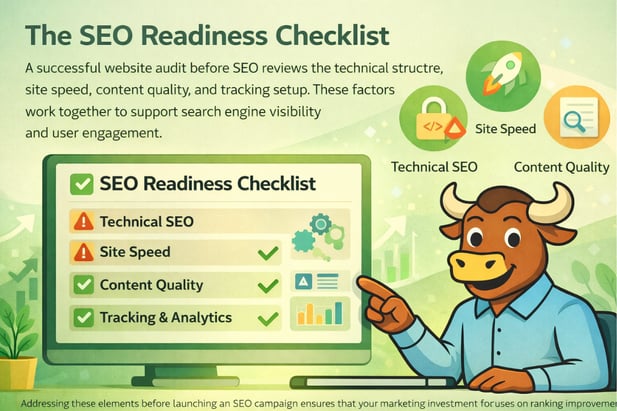
A successful website audit before SEO reviews the technical structure, site speed, content quality, and tracking setup. These factors work together to support search engine visibility and user engagement.
Addressing these elements before launching an SEO campaign ensures that your marketing investment focuses on ranking improvements rather than repairing fundamental problems.
Technical Issues Hurting Your SEO
Technical SEO issues often prevent search engines from discovering and indexing important pages. Crawlability refers to the ability of search engine bots to navigate your site, while indexing determines whether those pages appear in search results.
Problems such as robots.txt blocks, broken links, and duplicate URLs waste crawl budget and limit your site's visibility. A website audit before SEO identifies these problems early.
| Technical Issue | Description | Fix Requirement |
|---|---|---|
| Crawl Errors | Search engines encounter broken paths or redirect loops. | Repair or redirect broken pages. |
| Robots.txt Blocks | Important pages are blocked from search engines. | Update the robots.txt file. |
| Missing XML Sitemap | Search engines lack a clear map of the site. | Submit a dynamic sitemap. |
| Duplicate Content | Multiple pages contain the same content. | Use canonical tags or redirects. |
| Broken Links | Links lead to error pages. | Replace or remove invalid links. |
Performance and Core Web Vitals
Page speed is a confirmed ranking factor. Google measures site performance through Core Web Vitals which evaluate loading speed, interactivity, and visual stability.
Slow websites frustrate users and increase bounce rates. If visitors leave quickly, Google may interpret this behavior as a sign that the page does not meet search intent.
| Performance Signal | SEO Ready | Needs Improvement |
|---|---|---|
| Largest Contentful Paint | Under 2.5 seconds | Over 4 seconds |
| First Input Delay | Under 100 milliseconds | Over 300 milliseconds |
| Cumulative Layout Shift | Under 0.1 | Over 0.25 |
| Mobile Experience | Fully responsive | Difficult navigation on mobile |
Site Architecture and Internal Linking
Site architecture determines how pages are organized and connected. A clear structure helps both users and search engines understand the relationships between pages.
Strong internal linking distributes ranking authority across the website. It also prevents orphan pages that cannot be discovered easily by search engines.
Clean URLs also improve clarity. For example, a URL such as /services/seo-audit/ communicates the page topic clearly, while random characters provide little context.
Content Quality and Topical Authority
Content plays a critical role in SEO success. Thin pages with little value rarely rank well because they do not satisfy search intent.
High quality websites build topical authority by covering subjects in depth. Instead of publishing scattered content, focus on creating comprehensive guides and detailed service pages.
| Content Type | Low SEO Value | High SEO Value |
|---|---|---|
| Service Pages | Short descriptions with little detail | Comprehensive explanations with benefits and FAQs |
| Blog Articles | Generic posts without keyword focus | Detailed guides solving real problems |
| Company Pages | Minimal information | Clear expertise and trust signals |
Conversion Optimization and User Experience
SEO increases traffic, but conversion optimization turns visitors into leads or customers. If landing pages lack clear calls to action, additional traffic may not improve revenue.
Navigation should be simple and intuitive. Visitors should easily find contact forms, pricing information, or service pages without searching through multiple menus.
Align landing pages with search intent. When someone searches for a specific service, the page should address that service directly rather than redirecting them to a generic homepage.
Analytics, GA4, and Search Console
Data is essential for measuring SEO performance. Google Analytics 4 tracks user behavior, while Google Search Console provides insights into search visibility and indexing issues.
Without proper tracking, it is impossible to determine whether your SEO investment is producing meaningful results.
Ensure that conversion tracking is configured correctly. This allows you to measure leads, form submissions, and sales generated through organic search.
When Are You Actually Ready for SEO
Your website is ready for SEO when it is technically stable, fast, and user friendly. A well organized structure and high quality content provide a strong foundation for ranking improvements.
Sites that pass technical audits, load quickly on mobile devices, and provide clear conversion paths are positioned to benefit most from SEO strategies.
The Cost of Ignoring Foundational Issues
Skipping a website audit before SEO can lead to wasted marketing budgets. Businesses sometimes spend thousands of dollars each month on optimization while technical problems prevent their pages from ranking.
Investing in technical improvements first ensures your SEO efforts focus on growth rather than troubleshooting.
| Approach | Investment Focus | Expected Outcome |
|---|---|---|
| SEO Without Preparation | Content and backlinks on a broken site | Slow progress and limited visibility |
| Foundation First | Technical improvements and user experience | Faster rankings and stronger conversions |
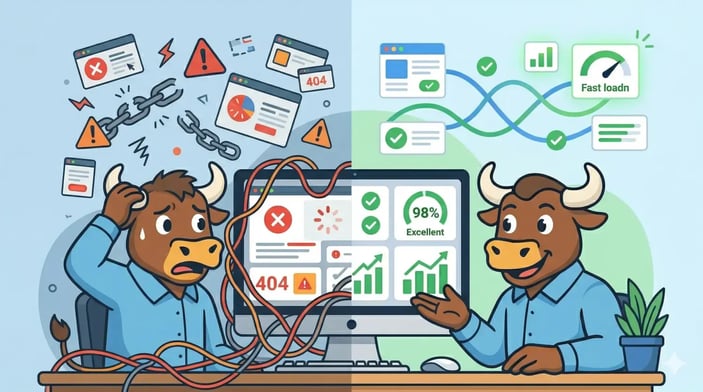
The Ultimate Website Audit Before SEO Checklist
| Category | Checklist Item | Status |
|---|---|---|
| Technical | Resolve all crawl errors | Pending or Completed |
| Technical | Verify robots.txt configuration | Pending or Completed |
| Technical | Submit XML sitemap | Pending or Completed |
| Performance | Optimize images and loading speed | Pending or Completed |
| Performance | Pass Core Web Vitals evaluation | Pending or Completed |
| Structure | Improve internal linking | Pending or Completed |
| Content | Create dedicated pages for services | Pending or Completed |
| UX | Add clear calls to action | Pending or Completed |
| Analytics | Install GA4 tracking | Pending or Completed |
| Analytics | Verify Google Search Console | Pending or Completed |
Building a Stronger Online Presence
Completing a website audit before SEO helps businesses create a reliable digital foundation. By resolving technical problems and improving user experience, you create a website that both search engines and visitors trust.
When your site is technically sound and content is well structured, SEO becomes a powerful growth strategy rather than an expensive experiment.
Frequently Asked Questions
What is a website audit before SEO
A website audit before SEO evaluates the technical health, content quality, and performance of a site before launching an optimization campaign. It helps identify issues that could prevent pages from ranking in search engines.
What should be fixed before starting SEO
You should fix crawl errors, broken links, slow page speed, and missing tracking tools before beginning SEO. Addressing these issues ensures that search engines can properly index your content.
Why do SEO campaigns fail
SEO campaigns often fail when technical problems prevent search engines from understanding the site. Poor user experience and weak content also reduce ranking potential.
How do I know if my website is ready for SEO
A website is ready for SEO when it loads quickly, has no major crawl errors, and provides clear navigation and content. Proper analytics tracking should also be installed.
Can SEO work on a slow website
SEO is much less effective on slow websites because page speed is a ranking factor. Improving performance is essential before investing heavily in optimization.
What technical issues hurt SEO the most
Issues that block crawling or indexing cause the most damage to SEO performance. Examples include robots.txt blocks, duplicate content, and broken internal links.