TLDR / Key Summary:
Google Ads are not going away in the AI Mode era. They are being rebuilt for it.
As Google shifts from traditional search results to AI-generated answers, advertisers now have new placement opportunities inside and around those AI responses.
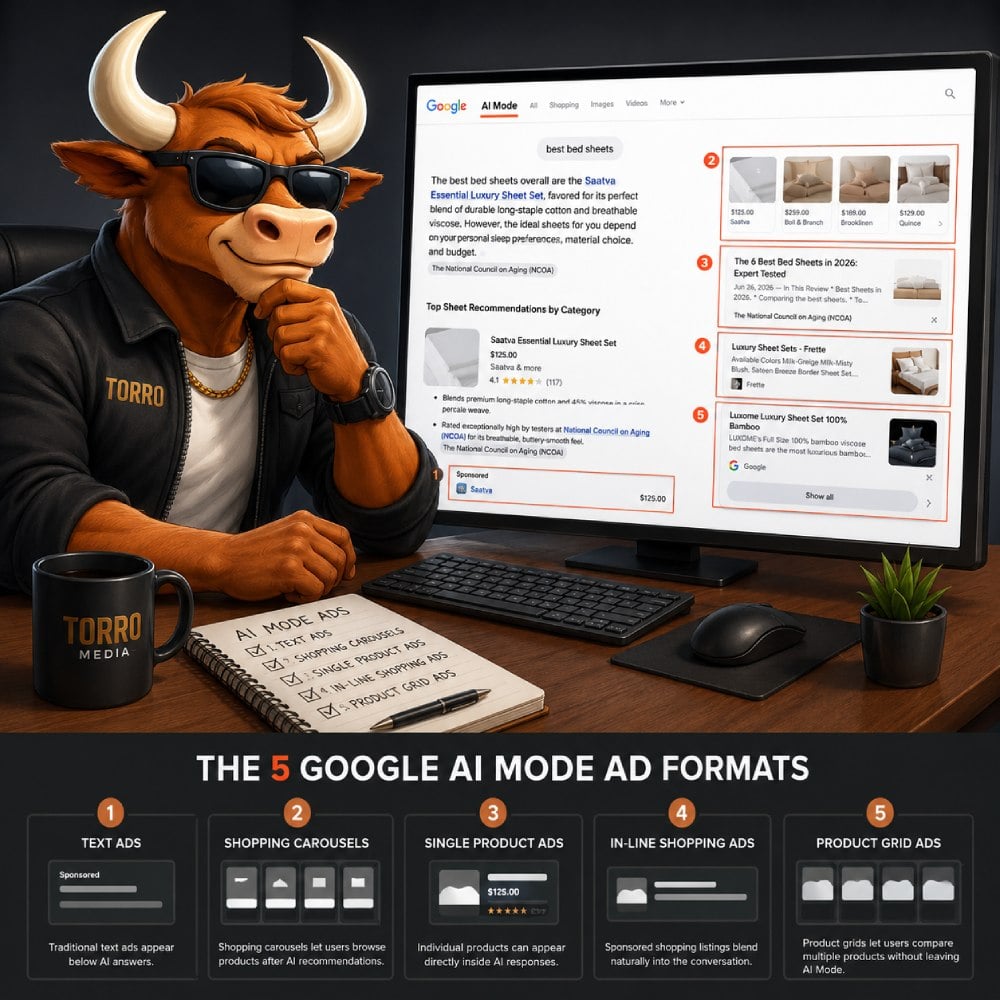
The five Google AI Mode ad formats currently showing are:
- Bottom text-based ads
- Bottom shopping carousel ads
- In-line single product shopping ads
- In-line non-rich shopping ads
- Sponsored product grid ads
The big shift is this: Google Ads are moving from keyword-only placement to intent-based placement inside the full search journey.
That matters because zero-click behavior is rising fast. SparkToro reported that 68.01% of U.S. Google searches ended without a click in 2026, up from 60.45% in 2024.
Google’s own positioning is clear: in AI Mode, ads are designed to help users move from discovery to decisions inside the AI experience itself.
Why AI Mode Ads Matter
For years, Google Ads worked because people searched with intent.
Someone typed:
- best emergency plumber near me
- buy running shoes for flat feet
- Google Ads agency for local business
Then Google showed ads above the organic results.
AI Mode changes the shape of that journey.
Now the user may ask a longer, more detailed question:
What’s the best HVAC company near me that can replace a commercial rooftop unit and has strong reviews?
Instead of showing ten blue links, Google can generate an answer, compare options, summarize products, and place ads directly where the decision is happening.
That is the part business owners need to understand.
Google Ads are not just showing before the answer anymore. They are starting to show inside the answer, below the answer, and alongside the next step.
Google VP and GM of Ads Vidhya Srinivasan described the shift as ads becoming more helpful in the exact moment people are looking for answers.
That is the opportunity.
Not more traffic. Better intent.
The 5 Google AI Mode Ad Formats
1. Bottom Text-Based Ads
%20in%20AI%20Mode.png?width=1287&height=983&name=1%20Bottom%20Text-Based%20Ads%20(Stacked)%20in%20AI%20Mode.png)
These look closest to traditional Google Search ads.
They usually appear near the bottom of an AI Mode response after Google has already answered the user’s question. The ads are stacked vertically and include familiar text ad elements like:
- Sponsored label
- Headline
- Description
- Business name or domain
- Sitelink-style extensions
Why this matters
This format is likely to be one of the easiest transitions for advertisers already running Search campaigns.
The ad does not interrupt the AI answer. It shows up as the logical next step after the user has received context.
For service businesses, this could be extremely valuable.
Example: A user asks AI Mode, “What should I know before hiring a personal injury lawyer after a car accident?”
After Google explains the basics, a sponsored law firm ad can appear below the answer.
That placement is powerful because the user is no longer casually searching. They are educated, warmed up, and closer to taking action.
Best for
Local services, legal, healthcare, finance, home services, B2B lead generation, SaaS, and high-intent service searches.
What advertisers should do
Make sure your Search campaigns are built around clear intent, strong landing pages, and conversion tracking. Generic keyword stuffing will matter less. Clear offers, proof, and relevance will matter more.
2. Bottom Shopping Carousel Ads
%20in%20AI%20Mode.png?width=1243&height=979&name=2%20Bottom%20Shopping%20Carousel%20Ads%20(Row)%20in%20AI%20Mode.png)
This format shows product ads in a horizontal carousel near the bottom of the AI Mode response.
It is very similar to familiar Shopping ads, but the context is different. The user has likely asked a broader research question, and Google is using the AI answer to narrow the options before showing products.
Example: “What are the best shoes for marathon training if I overpronate?”
AI Mode may explain what overpronation means, what features matter, and then show a carousel of sponsored products that match the need.
Why this matters
Shopping ads become more consultative.
The ad is not just showing because someone typed “running shoes.” It may show because Google understands the full conversation around foot type, training goal, budget, brand preference, and use case.
That is a major shift.
Best for
Ecommerce brands, retail, apparel, footwear, electronics, home goods, beauty, and any product category where comparison shopping matters.
What advertisers should do
Your Merchant Center feed needs to be clean. Product titles, descriptions, images, reviews, pricing, promotions, and attributes matter more than ever.
AI Mode can only match your products well if your product data is complete and specific.
3. In-Line Single Product Shopping Ads
%20in%20AI%20Mode.png?width=1001&height=945&name=3%20In-Line%20Shopping%20Singular%20Ads%20(Product%20Mixing)%20in%20AI%20Mode.png)
This is one of the most important AI Mode ad formats.
Instead of showing a carousel after the answer, Google can insert one sponsored product directly inside the AI response.
That means the ad appears as part of the decision-making flow.
Example: “What’s a good office chair for lower back pain under $300?”
Google may explain what to look for, then insert a specific sponsored chair as a relevant option inside the answer.
Why this matters
This is where Google Ads starts feeling less like a separate ad unit and more like a recommendation.
That can be very good for advertisers, but only if the product is genuinely relevant.
Bad product matching will feel forced. Good product matching will feel helpful.
Best for
Products with clear use cases, strong reviews, competitive pricing, and specific buyer intent.
What advertisers should do
Stop relying only on generic product titles.
A title like Black Office Chair is weak.
A title like Ergonomic Mesh Office Chair with Lumbar Support gives Google more context.
The more specific your feed is, the better chance you have of showing up in these AI-assisted product recommendations.
4. In-Line Shopping Ads
%20in%20AI%20Mode.png?width=1052&height=936&name=4%20In-Line%20Shopping%20Ads%20(Non-Rich)%20in%20AI%20Mode.png)
This format appears inside the AI response but is less visual than the richer product placements.
It may include a sponsored product mention, brand name, product detail, or shopping result without the full visual card treatment.
Why this matters
This format gives Google more flexibility.
Not every commercial result needs a big product image or carousel. Sometimes a simpler sponsored mention is enough.
That could become especially important in searches where the user is comparing features, prices, or options but is not ready for a full product grid yet.
Best for
Mid-funnel shopping queries, product research, comparisons, and category-level searches.
What advertisers should do
Build campaigns and feeds around how people actually describe the problem.
Not just:
men’s jacket
But:
lightweight waterproof jacket for travel
AI Mode is built for detailed intent. Your product data and ad strategy should match that.
5. Sponsored Product Grid Ads
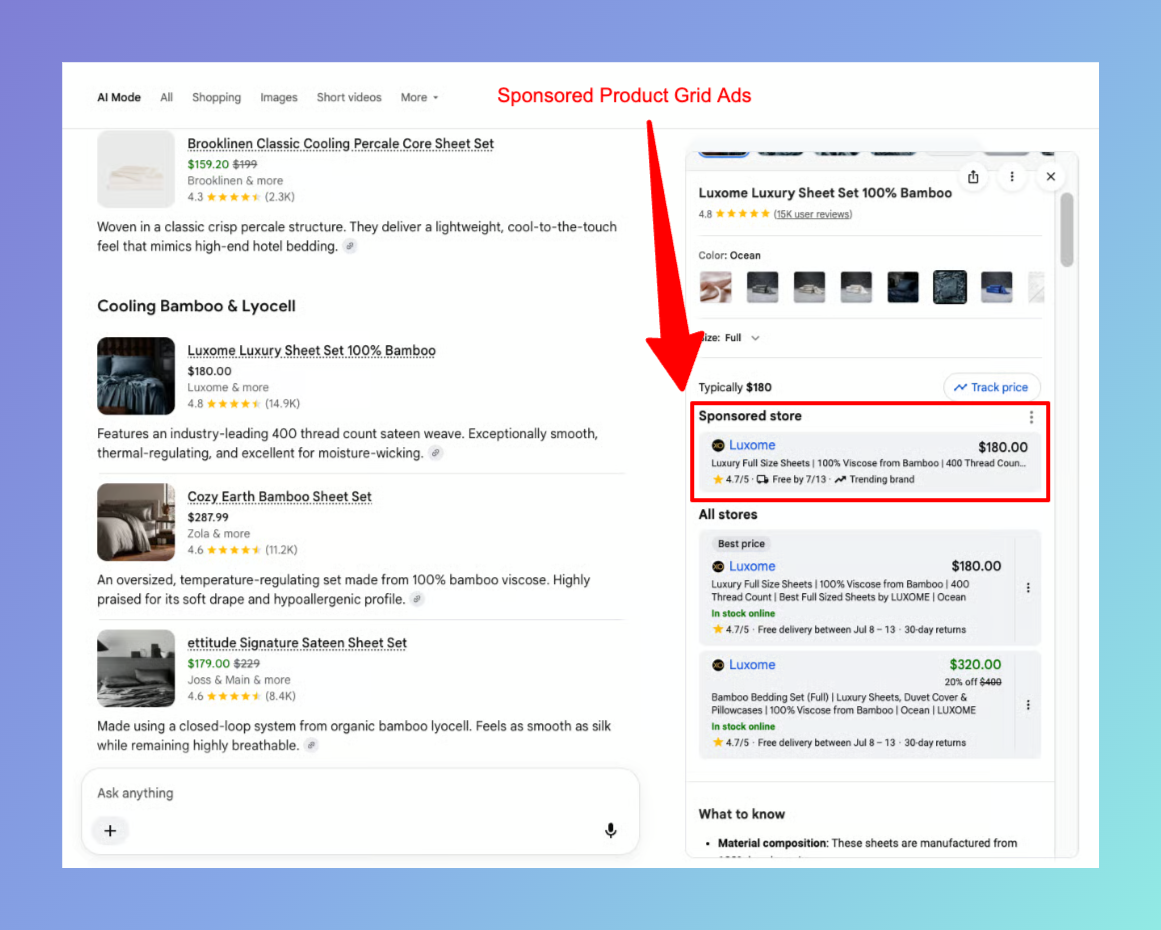
This format shows multiple sponsored products in a grid layout.
It is more visual and more comparison-driven than the single product placements.
Example: “Compare the best carry-on luggage options for international travel.”
Google can generate a buying guide and then show a sponsored grid of relevant luggage products.
Why this matters
This may become one of the most valuable formats for ecommerce brands.
The product grid gives users options without forcing them to leave Google immediately. That fits the zero-click future perfectly.
The user can compare, filter mentally, and choose a next step from inside the AI experience.
Best for
Ecommerce categories with multiple comparable products, including:
- Shoes
- Apparel
- Furniture
- Travel gear
- Electronics
- Fitness equipment
- Beauty products
- Home products
What advertisers should do
Your product feed is now your sales pitch.
Images, pricing, reviews, availability, shipping, promotions, and product attributes all influence how competitive you look inside the grid.
Will Google Ads Still Work in the Zero-Click Future?
Yes, but the strategy has to change.
Google Ads will still work because commercial intent is not disappearing.
People will still need:
- A plumber
- A lawyer
- A dentist
- A contractor
- A pair of running shoes
- A hotel
- A software tool
- A local business they can trust
What is changing is how much of the research happens before the click.
In the old model, the click started the education process.
In the AI Mode model, the education may happen directly on Google. The click comes later, when the user is more informed and more selective.
That means weaker advertisers will feel more pressure.
Stronger advertisers may get better leads.
What Google Ads Professionals Should Do Now
1. Fix your conversion tracking
If you cannot clearly measure calls, form fills, purchases, booked appointments, and qualified leads, AI Mode will make reporting messier.
Track the real business outcome, not just the click.
2. Improve your landing pages
AI Mode may reduce low-intent clicks. The people who do click may be further along.
Your landing page needs to answer:
- Why you?
- Why now?
- What proof do you have?
- What should I do next?
3. Use Performance Max carefully
Google has said ads in AI Mode can be eligible through existing campaign types like Performance Max and Search.
That does not mean you should blindly hand everything to automation.
Use strong creative, clean feeds, proper audience signals, and real conversion data.
4. Strengthen your Merchant Center feed
For ecommerce, this is non-negotiable.
Better product data gives Google more to work with inside AI-generated shopping experiences.
5. Build trust outside the ad
AI Mode is going to reward brands that look credible.
That includes:
- Reviews
- Case studies
- Local SEO
- Helpful content
- Clear service pages
- Strong product data
- Consistent brand mentions
- Accurate business information
Your ad account cannot carry a weak brand forever.
What Business Owners Should Take Away
AI Mode does not mean Google Ads are dead.
It means Google Ads are becoming more integrated into the customer’s decision process.
The businesses that win will not be the ones simply bidding the most. They will be the ones with the clearest offer, strongest proof, best tracking, and most helpful information.
In the old version of Google, you paid to show up.
In the AI Mode version of Google, you need to be useful enough to belong in the answer.
That is the real shift.
FAQs
What are Google AI Mode ads?
Google AI Mode ads are sponsored placements that appear inside, below, or alongside AI-generated search responses. They can include text ads, shopping ads, product carousels, single product placements, and sponsored product grids.
Are Google Ads going away because of AI Mode?
No. Google Ads are being redesigned for AI-powered search. Ads are expected to become more contextual, more visual, and more tied to the user’s full search journey.
Can local businesses show ads in AI Mode?
Yes. Local service businesses may benefit from AI Mode ads because users often ask detailed, high-intent questions before contacting a provider.
Do ecommerce brands need to change their Google Ads strategy?
Yes. Ecommerce brands should prioritize Merchant Center feed quality, product attributes, reviews, pricing, images, and Performance Max structure.
What is the biggest risk with AI Mode ads?
The biggest risk is poor tracking. If advertisers only measure clicks, they may miss how AI Mode changes the path to conversion.