
If you have ever looked at an account with a huge following and thought, “They must be crushing it,” you are not alone. But followers are not the same thing as results. Engagement is.
Engagement tells you if people actually care. It shows whether your content is landing, whether your message is clear, and whether your audience is paying attention long enough to take action. Followers are just a number. Engagement is proof.
Key Summary
- Engagement is a stronger signal of content quality than followers, it shows real attention and intent.
- High engagement improves distribution, retention, and conversion opportunities across platforms.
- Followers can be inflated, passive, or irrelevant, engagement is harder to fake and easier to tie to outcomes.
- One engaged community can outperform a large audience that never interacts.
- Focus on content that earns saves, shares, comments, and replies, those are the actions that build momentum.
What “Engagement” Actually Means
Engagement is any meaningful interaction someone takes with your content. The exact options vary by platform, but the idea is the same, people do something instead of scrolling past.
Common engagement signals include likes, comments, shares, saves, replies, link clicks, profile visits, and watch time. Not all engagement is equal, but each action tells you something about intent.
Here is a simple way to think about it. A like is a quick nod. A comment is a conversation starter. A share is someone putting their name on your content. A save is someone saying, “I want this later.”
And the strongest signal across most platforms is time. If people stop, watch, rewatch, and keep going, you earn attention. That is the currency.
Why Followers Can Mislead You
Followers feel good because they are visible. They are also one of the easiest metrics to misunderstand.
Here is why followers can be misleading.
- (Not used) Followers do not guarantee reach. Platforms do not show every post to every follower.
- Followers do not guarantee interest. Many follow out of curiosity, and then never interact again.
- Followers do not guarantee buying intent. Someone can enjoy your content and still never become a customer.
- Followers can be inflated. Giveaways, trend spikes, and low intent followers can grow a number without growing a business.
You can have 50,000 followers and still feel like you are talking to a wall. You can also have 1,500 followers and consistently drive leads, sales, and referrals. The difference is engagement.
Engagement Is the Metric That Connects to Outcomes
If you run a business, you care about outcomes. More calls. More consults. More email signups. More purchases. More booked appointments. More brand trust. More word of mouth.
Engagement is what moves people from “I saw this” to “I remember this” to “I trust this” to “I will do something about this.”
Followers do not tell you whether that journey is happening. Engagement does.
When someone comments with a question, that is a sales signal. When someone shares your post, that is distribution plus validation. When someone saves a post, that is future intent. When someone watches a video all the way through, that is attention and interest.
Engagement Helps Platforms Decide What to Show
Most social platforms are built around one goal, keep people on the platform. The algorithm is not personal, it is practical. If your content holds attention and triggers interaction, it is more likely to get shown again.
This is why engagement tends to compound. A post that earns strong watch time and saves gets pushed wider. That wider reach creates more chances for engagement. That engagement creates more distribution.
You do not need a huge follower count to benefit from this. You need content that performs with the audience it is shown to.
If you want to hear this straight from the source, here is a clip from the head of Instagram, Adam Mosseri, talking about engagement and what actually matters: watch the video here.
Why Engagement Matters More Than Followers for Brand Trust
Trust is not built by numbers. It is built through repeated positive interactions.
Engagement is where those interactions happen. A comment thread is a public relationship. A reply in your DMs is a private relationship. A share from someone respected in your niche is borrowed credibility.
When your content sparks real conversation, your brand stops feeling like “another account” and starts feeling like a person or a team that understands the audience.
And trust is the thing that converts, especially in competitive markets where everyone looks the same on paper.
Engagement vs Followers, A Quick Example
Let’s compare two accounts.
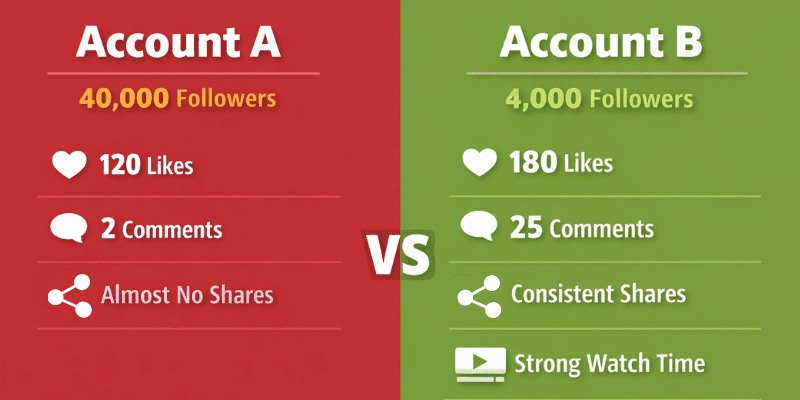
Account A has 40,000 followers. Their posts average 120 likes, 2 comments, and almost no shares.
Account B has 4,000 followers. Their posts average 180 likes, 25 comments, and consistent shares. Their videos get strong watch time, and people ask questions weekly.
Account B is the one that will usually win. Not because they are “bigger,” but because they are more relevant. They have an audience that is paying attention.
If you are trying to grow a brand, relevance beats size.
The Engagement Signals That Matter Most
Every platform weighs engagement differently, but these signals usually mean more than simple likes.
Saves
Saves suggest long-term value. Someone is telling you, “This is useful enough to keep.” Educational content, checklists, quick tips, templates, and strong opinions tend to earn saves.
Shares
Shares are distribution plus endorsement. People share content that makes them look smart, helpful, funny, or “in the know.” If you want shares, aim for content that is easy to agree with or easy to use.
Comments and Replies
Comments show involvement. Replies show conversation. If your post gets a lot of “this is so true” comments, that can still help, but questions and longer comments are even better. They show deeper interest.
Watch Time and Rewatches
For video, this is massive. A short video that gets rewatched can outperform a longer video with more likes but poor retention. If people watch to the end, you did your job.
Clicks and Profile Actions
Clicks, profile visits, and follows after viewing a post are strong intent signals. They show your content is not just entertaining, it is pulling people closer to your brand.
What to Post If You Want Better Engagement
If you are tired of chasing followers and want engagement that actually leads to growth, you need content that invites action. Here are formats that usually perform well across industries.
- (Not used) Replace “strong” with normal text, here is the idea: teach something specific. One topic per post.
- Answer one common question your audience asks, and answer it clearly.
- Myth vs reality posts that correct a misconception.
- Behind the scenes content that shows how you work, how you think, and what you care about.
- Before and afters with real context, what changed, why it mattered, what the result was.
- Opinion posts that take a clear stance (without being performative).
- Story posts with a lesson, what happened, what you learned, what others can apply.
The goal is not to post more. The goal is to post with intention.
How to Improve Engagement Without Changing Your Whole Content Strategy
You do not need a full rebrand to earn better engagement. Small changes can make a big difference.
Start With One Clear Hook
Don’t warm up for 10 seconds. Get to the point. Lead with the problem, the surprising truth, or the outcome.
Make It Easy to Respond
End posts with a question that is specific. “Thoughts?” is vague. “Which one are you seeing most right now, A or B?” gets answers.
Write Like a Human Talks
People engage with people. Drop the corporate voice. Keep it clear. Keep it direct. Use short sentences.
Give People a Reason to Save or Share
If your content is purely “look at us,” it may earn a like, but it rarely earns a save. Add utility. Add a takeaway. Add a framework.
Use Proof
Specifics earn trust. Show results. Share a lesson from a real example. Explain the process. People engage more when they believe you.
The Followers Trap, When “Growth” Hurts Performance
Sometimes chasing followers actively makes your content worse.
Here is how that happens.
- You start posting for everyone, which means it resonates with no one.
- You chase trends that do not match your audience, so your followers grow but your engagement drops.
- You attract low intent followers with giveaways, then your future posts underperform because that audience is not actually interested.
It is not that followers are bad. It is that follower growth without engagement is a weak foundation.
If your goal is a healthy account, aim for engaged followers, not just more followers.
Engagement Benchmarks (What “Good” Looks Like)
Benchmarks vary by platform, industry, and account size. Bigger accounts often have lower engagement rates because the audience is broader. Smaller accounts can look “better” because the audience is tighter.
Instead of obsessing over a universal number, track these trends:
- Are comments getting longer and more specific?
- Are shares increasing month over month?
- Are saves consistent on your educational posts?
- Are you seeing more DMs that reference your content?
- Are posts driving profile visits, clicks, and inquiries?
If those are improving, you are moving in the right direction, even if follower growth is slow.
A Simple Engagement-First Content Plan
If you want a practical way to refocus, try this simple weekly structure.
- One educational post that teaches a specific concept.
- One proof post that shows results, a case study, a lesson learned, or a before and after with context.
- One conversation post that asks a specific question and invites replies.
- One behind the scenes post that shows how you work, think, or decide.
This keeps your content balanced. It also creates multiple entry points for engagement, saves, shares, comments, and DMs.
FAQ
Is it still important to grow followers?
Yes, but followers should be a byproduct of strong content, not the main objective. When you focus on engagement, follower growth tends to become more consistent because the right people are finding you and sticking around.
What is the best type of engagement to aim for?
It depends on your goal. If you want reach, aim for shares and watch time. If you want leads, aim for comments, DMs, clicks, and profile actions. If you want long-term authority, aim for saves and shares on educational posts.
Why do I have followers but low engagement?
Common causes include attracting the wrong audience, posting content that is too broad, inconsistent posting, weak hooks, or content that does not give people a reason to interact. It can also happen after giveaways or trend spikes that pull in low intent followers.
How do I increase engagement fast?
Start by tightening your topic focus, improving your first line or first three seconds, and ending posts with a specific question. Then build more “saveable” content, like quick frameworks, checklists, and clear opinions backed by proof.
Does engagement matter more than followers for businesses?
In most cases, yes. Businesses need attention that turns into trust and action. Engagement is the clearest signal that your audience is not just present, they are paying attention and responding.
Should I delete followers that do not engage?
Usually no. It is more effective to improve content and let the platform find the right audience over time. If you have a very specific reason (like cleaning up bot accounts), then it can make sense, but it is rarely the main lever for better engagement.