
Most businesses assume their PPC agency is optimizing for results. But in reality, many agencies are optimizing for spend, not profit. If you’ve run Google Ads before and felt like you were pouring money in without clear returns, you’re not alone. This breakdown explains why it happens, how to spot it, and what to do instead.
TLDR / Key Summary
-
Most PPC agencies are incentivized to increase spend, not profit
-
Metrics like clicks and impressions do not equal revenue
-
Profit-focused PPC relies on CPA, ROAS, and real business data
-
If your budget is rising without better results, that’s a red flag
-
The right strategy connects ad performance directly to revenue
What PPC Agencies Are Actually Optimizing For
PPC agencies are typically measured by how much they spend and how active the account looks. That’s the first problem.
PPC stands for pay-per-click advertising, where businesses pay each time someone clicks on their ad. But the goal should not be clicks. The goal should be profit.
Many agencies charge a percentage of ad spend. So if your budget increases, their fee increases. That creates a built-in incentive to spend more, not necessarily perform better.
And that’s where things break down.
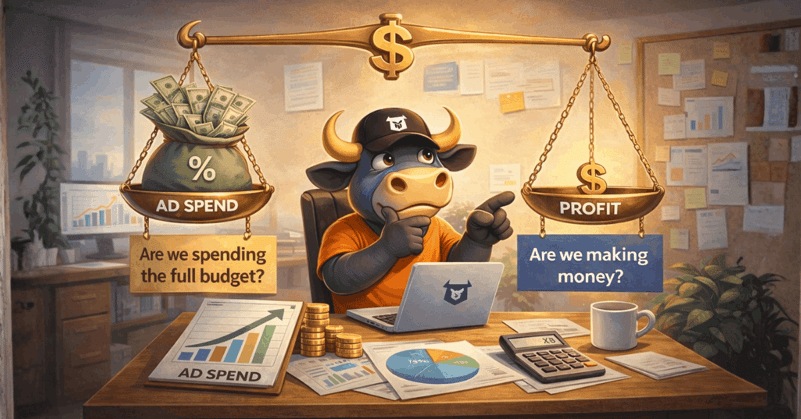
Instead of asking “Are we making money?”, the focus shifts to “Are we spending the full budget?”
Why Ad Spend Becomes the Focus Instead of Profit
This usually comes down to how agencies are structured and measured.
First, reporting often centers around surface-level metrics like impressions, clicks, and cost-per-click. These numbers look good in reports but don’t tell the full story.
Second, many agencies don’t have full visibility into your business. They don’t know your margins, your close rates, or your customer lifetime value. Without that, they can’t optimize for real profitability.
Third, there’s pressure to “show activity.” That leads to constant changes, budget increases, and campaign expansion even when it’s not justified.
According to WordStream, the average conversion rate across industries in Google Ads is about 6.11%. That means over 90% of clicks don’t convert. If your agency is focused only on driving clicks, most of your spend is doing nothing.
The Metrics That Actually Matter in PPC
If profit is the goal, the metrics need to reflect that.
Cost per acquisition (CPA) is one of the most important. This tells you how much it costs to generate a lead or customer.
Return on ad spend (ROAS) is another. This measures how much revenue you generate for every dollar spent.
Customer lifetime value (LTV) matters if you’re in a business where repeat customers drive growth.
And close rate connects your leads to actual revenue.
If your agency isn’t tying campaigns back to these metrics, they’re guessing.
This is where working with a partner that understands both marketing and business becomes critical. You can see how this connects to a broader strategy through Google Ads.
How to Tell If Your PPC Agency Is Focused on Spend
There are a few clear signs.
Your budget keeps increasing, but results don’t improve.
Reports highlight clicks, impressions, and traffic, but not revenue.
You don’t have clarity on what a lead or customer is worth.
There’s no conversation about profit margins or business goals.
And when performance drops, the answer is often “we need to spend more.”
If this sounds familiar, it’s worth stepping back and reassessing. You can also compare what you’re paying versus what you should expect in PPC Management Cost.
What a Profit-Focused PPC Strategy Looks Like
A profit-focused PPC strategy starts with your business, not the ad platform.
First, define what a conversion is worth. That could be a lead, a booked call, or a sale. Without this, nothing else matters.
Second, track conversions properly. That includes form submissions, calls, purchases, and anything tied to revenue.
Third, build campaigns around high-intent keywords. These are searches where the user is ready to take action, not just browse.
Fourth, optimize based on data, not activity. That means cutting what doesn’t work and doubling down on what does.
And finally, align reporting with business outcomes. If revenue isn’t increasing, the strategy needs to change.
This approach is part of a larger digital strategy. You can see how it fits into Digital Services.
How to Choose a PPC Agency That Actually Drives Profit
Choosing the right agency is less about credentials and more about how they think.
Ask how they measure success. If the answer is clicks or traffic, that’s a red flag.
Ask how they connect campaigns to revenue. If there’s no clear answer, they’re not set up for it.
Ask how they handle underperforming campaigns. The answer should not be “increase budget.”
And ask how they learn your business. If they don’t understand your numbers, they can’t optimize for them.
If you want a deeper breakdown, this guide covers it step by step: How to Choose the Right PPC Agency Without Wasting Ad Spend.
Or, if you’re already thinking about making a change, you can Request a Quote or Contact us to talk through your current setup.
How Long Does It Take for Google Ads to Become Profitable?
One of the most common questions businesses ask before starting Google Ads is how long it takes to actually become profitable. That is a fair question, because while clicks can come in quickly, profit usually takes more time. Campaigns need data, testing, and optimization before they start producing efficient results.
In most cases, Google Ads can begin generating early traffic and leads within days, but true profitability often takes several weeks. That depends on your offer, your landing pages, your market, your conversion tracking, and how well the account is managed. If expectations are off from the start, businesses often assume Google Ads is not working when the campaign simply has not matured yet.
To break this down more clearly, watch this video on how long it takes for Google Ads to become profitable and what businesses should realistically expect in the early phase of a campaign.
Why This Matters More Than Ever
Ad costs are rising. Competition is increasing. And platforms like Google Ads are getting more automated.
That means wasted spend adds up faster than ever.
According to Statista, global digital ad spend is expected to exceed $740 billion by 2026. More businesses are investing, but not all of them are seeing returns.
If your strategy is not tied to profit, you’re just contributing to that number.
And that’s not a position most businesses can afford to be in long term.
Frequently Asked Questions
Why do PPC agencies focus on ad spend?
PPC agencies focus on ad spend because many are paid as a percentage of spend. This creates an incentive to increase budgets rather than optimize for profit.
What should a PPC agency optimize for?
A PPC agency should optimize for profit, which includes metrics like cost per acquisition, return on ad spend, and customer lifetime value.
How do I know if my PPC campaigns are profitable?
You know your PPC campaigns are profitable when your revenue from ads exceeds your total ad spend and management costs.
What is a good return on ad spend?
A good return on ad spend depends on your margins, but most businesses aim for at least 3:1, meaning $3 in revenue for every $1 spent.
Can PPC work for small businesses?
PPC can work for small businesses when campaigns are targeted, tracked properly, and optimized for high-intent searches that lead to revenue.