
If your feed feels more manipulative than helpful lately, you are not imagining it. A lot of content in 2026 is built to trigger comments first and deliver value second. That tactic is called comment farming, and it is everywhere because social platforms still reward engagement signals like comments, replies, shares, and repeat views. What is comment farming?
Key Summary
-
Comment farming is the practice of creating content mainly to generate comments, not to create useful discussion.
-
In 2026, comment farming is common because platforms still treat engagement as a signal that content should be shown to more people.
-
Many creators now stack multiple engagement triggers into one post or video to boost reach.
-
High engagement does not always mean strong marketing, qualified traffic, or business intent.
-
Brands should focus on useful content, clear positioning, and real audience trust instead of empty engagement.
What Comment Farming Means
Comment farming is a content tactic designed to manufacture engagement. More specifically, it is the practice of publishing content that is intentionally made to get people to comment, usually with very little effort, thought, or buying intent behind those comments.
The simplest version is obvious. A creator posts something like “Comment YES if you agree” or “Which one are you picking?” The post is not trying to teach anything. It is trying to trigger activity.
A more advanced version is less obvious. Instead of directly asking for a comment, the creator bakes in a moment that makes viewers feel the need to respond. Maybe something looks wrong. Maybe something feels strange. Maybe a detail flashes by quickly enough to make people wonder if they really saw it.
That still counts as comment farming.
The point is the same. Create comments, boost engagement, and get more reach.
Why Comment Farming Works so Well on Social Platforms
Social platforms want signals that tell them what content people care about. Engagement is one of those signals. If a post gets a lot of comments, the platform often reads that as proof the post is interesting, relevant, or worth showing to more people.
That creates a simple incentive.
If comments help increase distribution, creators will build content that gets more comments.
Not better comments. More comments.
This is one of the biggest reasons comment farming has become so common. The reward system is still there. Even when the tactic is obvious, it can still work well enough to make creators keep using it.
And once enough people do it, the tactic spreads. One creator sees another creator get reach from it, then copies it. Soon, entire niches start using the same engagement tricks.
Why Comment Farming is Everywhere in 2026
Comment farming is everywhere in 2026 because organic reach is harder to earn with average content. There is more competition, more content, and more pressure to perform quickly.
For creators and brands chasing visibility, engagement shortcuts are tempting.
A thoughtful educational post can take time to make. A manufactured engagement post can be made fast. And in many cases, it will outperform the better post on surface-level metrics.
That is the tradeoff. Comment farming often looks good in analytics dashboards, especially if someone only looks at top-line engagement numbers. But a lot of those comments do not reflect trust, intent, or interest in buying anything.
That is where people get fooled.
What Comment Farming Looks Like in Real Life
The easiest way to understand comment farming is to see the patterns.
Some examples are obvious. “Agree or disagree?” “Would you do this?” “Drop a yes below.” These are straight engagement asks.
Other examples are more engineered.
A video might show a small mistake on purpose so viewers rush into the comments to point it out. A caption might be phrased in a way that invites correction. A post might frame a painfully simple opinion as a controversial take just to get people arguing.
And some creators have gotten very good at stacking multiple triggers into one short video.
How Ashton Hall Stacks Engagement Triggers Inside a Single Video
Another creator, Ashton Hall, is often used as a good example of how advanced comment farming can work in practice.
Instead of relying on one obvious prompt, he may use multiple passive triggers inside a single video.
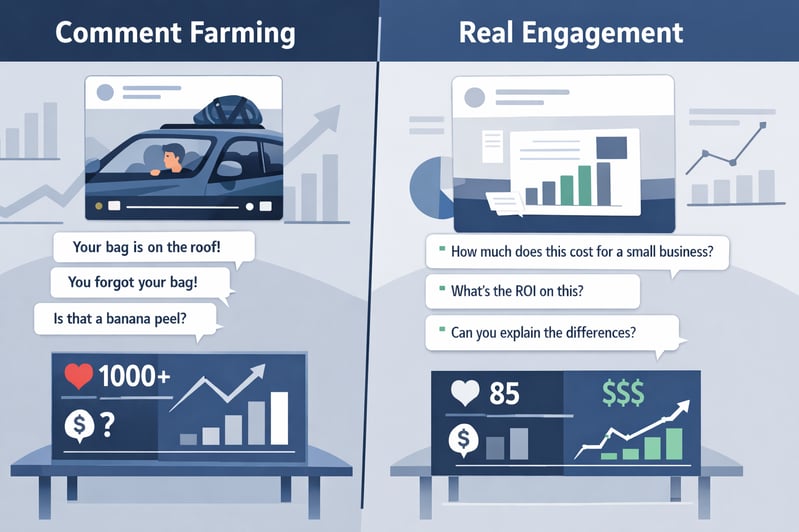
He might drive away with a gym bag on the roof of his car. People rush to the comments to warn him.
Your bag is on the roof.
You forgot your bag.
He might briefly rub a banana peel on his face for less than a second. Viewers comment to confirm what they saw.
Did anyone see that?
Why did he do that?
These triggers exist to manufacture engagement.
They create comments without creating business intent.
And that is what makes this tactic worth paying attention to. It is not always loud or obvious. Sometimes it is subtle. Sometimes it looks like an accident. Sometimes it is just weird enough to make people react.
But the strategy underneath it is the same. Make viewers feel like they have to say something.

Why Creators Use This Tactic
Creators use comment farming because it can improve reach without requiring much depth. It is a shortcut.
Instead of earning attention by teaching, entertaining, or building credibility, the creator engineers a response. That response becomes engagement. And that engagement can help the post travel further.
From a pure distribution standpoint, it makes sense.
From a business standpoint, it is often much weaker than it looks.
A post with 3,000 comments from people saying “your bag is on the roof” may look successful. But if those people are not potential customers, that engagement has limited value. The metric went up. Business intent did not.
The Difference Between Engagement and Business Intent
This is where a lot of marketers, founders, and business owners get misled.
Engagement is not automatically the same thing as demand. A comment does not equal interest. A share does not equal buying intent. A viral post does not automatically mean business growth.
Sometimes engagement matters a lot. Sometimes it is mostly noise.
Business intent is different. Business intent means the audience is moving closer to trust, consideration, and action. They are asking serious questions. They are clicking through. They are comparing options. They are trying to understand whether you can help them.
That is much more valuable than a pile of reaction comments from people who will never buy.
This is why brands need to be careful when evaluating social performance. High engagement can be useful. But only if it is connected to the right audience and the right next step.
Why Comment Farming Can Hurt Brands
Comment farming is not just harmless internet behavior. For brands, it can create real problems.
First, it can distort performance reporting. If a team sees strong engagement numbers, they may assume the content strategy is working even when leads, pipeline, or qualified traffic are flat.
Second, it can train a brand to create lower-quality content. Once a team gets rewarded for cheap engagement, it becomes easy to keep repeating the same tactic.
Third, it can weaken trust. Smart audiences notice when content is trying too hard to manipulate them. And once that pattern becomes obvious, the brand starts to feel less credible.
For a serious company, that is a bad trade.

What Real Engagement Looks Like
Real engagement is different from manufactured engagement.
Real engagement happens when someone comments because the content actually helped them think, learn, or make a decision. The comment is tied to interest.
It might look like this:
How much would this cost for a company our size?
We tried this and saw the same issue.
Can you explain the difference between these two options?
Those are better comments. They signal curiosity, relevance, and possible action.
That kind of engagement is much more useful to a business than a flood of empty reactions.
It is also much harder to fake.
What Brands Should do Instead of Comment Farming
Brands should focus on content that earns attention honestly.
That means answering real questions. Explaining confusing topics clearly. Sharing examples. Showing how things work. Giving people enough information to actually learn something.
This kind of content may not always spike on vanity metrics, but it tends to do something more important. It builds trust.
And trust compounds.
Over time, helpful content can support search, social, brand authority, and sales conversations all at once. That is why strong content strategy should not be built around whatever gets the fastest reaction. It should be built around what helps the right people move closer to a decision.
If a business wants better visibility without resorting to cheap engagement tactics, that usually means tightening up content strategy across channels. That can include stronger SEO Services, better audience targeting through Social Media Management, and clearer messaging that turns interest into action.
How to Tell if Your Content is Creating Real Value
A simple question helps here.
If the comments disappeared, would the content still be useful?
If the answer is no, that is a problem.
Good content should still hold up on its own. It should make sense. It should teach something. It should say something worth hearing, even without the engagement layer on top.
That is a much better standard than asking whether a post got enough comments.
It also helps filter out a lot of tactics that look smart in the short term but do very little for real business growth.
Why This Matters For Founders and Marketing Leaders
If you are a founder or marketing leader, this matters because content strategy affects more than social performance. It affects how your brand is perceived.
Cheap engagement tactics can create short-term visibility. But they can also make your brand feel shallow, reactive, or overly dependent on platform games.
That is not a strong position to defend internally. It is also not a strong long-term strategy.
What usually works better is a clear, practical approach. Build content around real customer questions. Create material that works on social, supports search, and makes sales conversations easier. Use engagement as a signal, not the goal itself.
That is the kind of strategy we believe in at Torro Media. Reputation over revenue only works if the content actually respects the audience.
The Bottom Line on Comment Farming
Comment farming is not hard to understand once you know what to look for. It is content engineered to create comments, often without creating much value.
That is why it is everywhere in 2026. It works well enough on platform algorithms to keep spreading.
But reach is not the same as trust. Comments are not the same as intent. And engagement is not the same as business growth.
The brands that win long term are usually the ones that stop chasing empty metrics and start building content that is actually worth paying attention to.
If you want help building a strategy around useful content, qualified traffic, and better marketing signals, you can Request a Quote or Contact us.
Frequently Asked Questions
What is comment farming?
Comment farming is the practice of creating content mainly to generate comments and boost engagement, often without providing much real value to the audience.
Why is comment farming effective on social media?
Comment farming is effective on social media because platforms often treat comments as a strong engagement signal, which can help a post reach more people.
Is comment farming the same as engagement?
Comment farming is not the same as meaningful engagement. Comment farming creates activity, while meaningful engagement reflects real interest, trust, questions, or buying intent.
Why is comment farming everywhere in 2026?
Comment farming is everywhere in 2026 because creators are under pressure to earn reach, and social algorithms still reward content that generates strong engagement signals.
How can brands avoid comment farming and still grow?
Brands can avoid comment farming by creating useful content that answers real questions, explains important topics clearly, and attracts the right audience instead of chasing empty engagement metrics.