Short-form content gets attention. Trust comes from something else.
Views do not equal belief. And belief is what drives buying decisions, referrals, and long-term brand equity.
People scroll past thousands of short clips a day. Most of them are forgotten instantly. The content that actually builds trust feels slower, deeper, and harder to fake.
Let’s break down what people are actually responding to, why it works, and how to use it without turning your brand into a content factory.
TLDR / Key Summary
- Long-form content builds the most trust because it proves depth and effort
- Honest negative reviews outperform polished positivity
- Real usage beats staged demos every time
- Community engagement signals legitimacy, not scale
- Track record matters more than trends
- Short-form content gets views, not trust
Why trust content matters more than reach
Trust reduces friction.
When people trust you, they do not need convincing. They do not need discounts. They do not need follow-ups.
- They buy faster.
- They recommend more.
- They stay longer.
This is why trust-focused content consistently outperforms viral content in revenue impact, even if it loses on raw views.

The most trusted content types, ranked
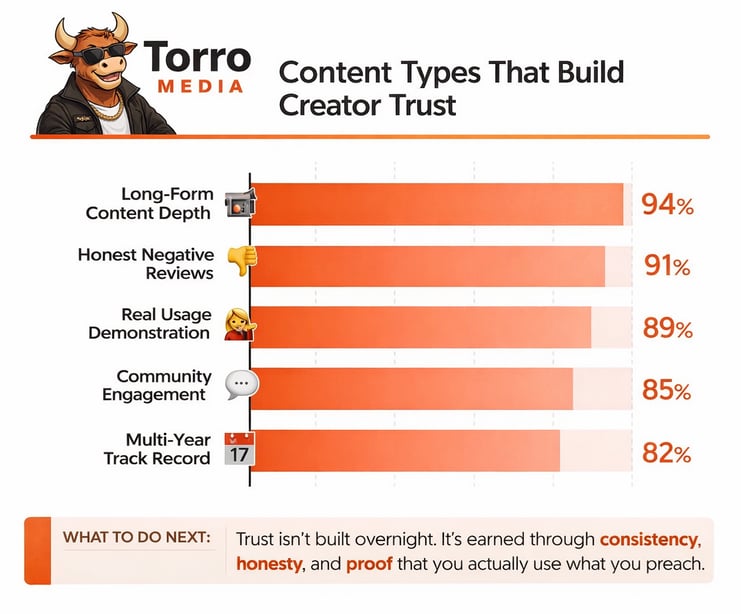
This ranking is based on how people report trust-building impact, not engagement metrics.
1. Long-form content depth
This is the top trust driver.
Long-form content works because it is expensive to fake. Time, structure, and thinking are visible.
Examples:
- Deep blog posts that answer real questions
- YouTube videos that explain the full process
- Podcasts where ideas are tested out loud
- Guides that show how decisions are actually made
Why it builds trust:
- It signals effort
- It exposes how you think
- It allows people to disagree and still respect you
If someone spends 10 minutes with your content, trust compounds automatically.
2. Honest negative reviews
This surprises people, but it should not.
Negative reviews build trust because perfection feels fake.
What works:
- Calling out who your product is not for
- Admitting tradeoffs
- Explaining failures and lessons learned
- Comparing yourself honestly to competitors
Why it builds trust:
- It lowers skepticism
- It shows confidence
- It removes sales pressure
People trust brands that are willing to lose the wrong customer.

3. Real usage demonstration
This is not a demo. It is proof.
Real usage means:
- Screen recordings of real workflows
- Behind-the-scenes footage
- Messy environments
- Unedited outcomes
Why it builds trust:
- It removes theory
- It shows results in context
- It proves the product exists in real life
If your content looks too clean, people assume it is staged.
4. Community engagement
Engagement is not likes. It is response.
What builds trust:
- Replying to comments thoughtfully
- Answering tough questions publicly
- Letting customers speak without scripting
- Highlighting user feedback, good and bad
Why it builds trust:
- It shows accountability
- It shows real demand
- It proves people care enough to talk back
Silence kills trust faster than criticism.
5. Multi-year track record
Longevity beats novelty.
Trust comes from repetition over time, not one breakout moment.
What this looks like:
- Dated case studies
- Long-standing customer relationships
- Old content that still holds up
- Consistent positioning across years
Why it builds trust:
- It signals durability
- It filters out hype
- It proves relevance beyond trends
People trust brands that survive cycles.
Why short-form content ranks last for trust
Short-form content is not bad. It is just incomplete.
The problem:
- It optimizes for attention, not understanding
- It removes nuance
- It encourages oversimplification
- It is easy to fake
Short-form content is a door. Not the house.
It should point somewhere deeper, or it loses trust value fast.
The mistake most brands make
They treat all content the same.
They chase:
- Views
- Reach
- Frequency
Instead of building:
- Depth
- Proof
- Continuity
Trust content compounds. Viral content resets every post.
How to use this without posting less
This is not about choosing one format.
It is about hierarchy.
Use short-form to:
- Introduce ideas
- Spark curiosity
- Earn the click
Use trust content to:
- Answer fully
- Show proof
- Close the loop
Short-form opens the door.
Long-form builds the relationship.

What this really means for your brand
If your content strategy stops at attention, your revenue will too.
If your content strategy builds trust, everything downstream gets easier.
Less convincing.
Shorter sales cycles.
Stronger referrals.
That is the difference.
And it is why the most trusted brands always feel slower, quieter, and more confident than everyone else.